

The Ultimate Guide to SEO Web Design Services: Merging Aesthetics with Search Power
Why Your Website Needs to Be Built for Both People and Search Engines
SEO web design services combine two things that should never be separated: a website that looks great and one that ranks on Google.
Here’s the quick answer if you’re in a hurry:
What are SEO web design services?
- A professional service that builds websites designed to rank in search engines and convert visitors into customers
- SEO (search engine optimization) is built into the site’s structure, code, and content from day one — not added later
- Key elements include mobile-friendly design, fast load times, clean site structure, keyword-optimized content, and technical SEO (schema, meta tags, internal linking)
- The goal: get found by the right people, keep them on your site, and turn them into leads or paying customers
Think about this: 94% of first impressions are shaped by a website’s design and navigation. At the same time, 70% of search users never scroll past page one of Google results.
That means a website that looks great but doesn’t rank is invisible. And a website that ranks but feels broken will drive people away — 88% of online shoppers who have a bad experience won’t come back.
Most businesses get one or the other. The smart move is to build both at once.
I’m Josh Preece, founder of J&A Digital Solutions, and over 20+ years of building websites for businesses ranging from large corporations to local contractors, I’ve seen how SEO web design services done right can transform a business’s ability to generate consistent, local leads. In this guide, I’ll walk you through everything you need to know — from core design principles to technical SEO — so you can make confident decisions about your website.
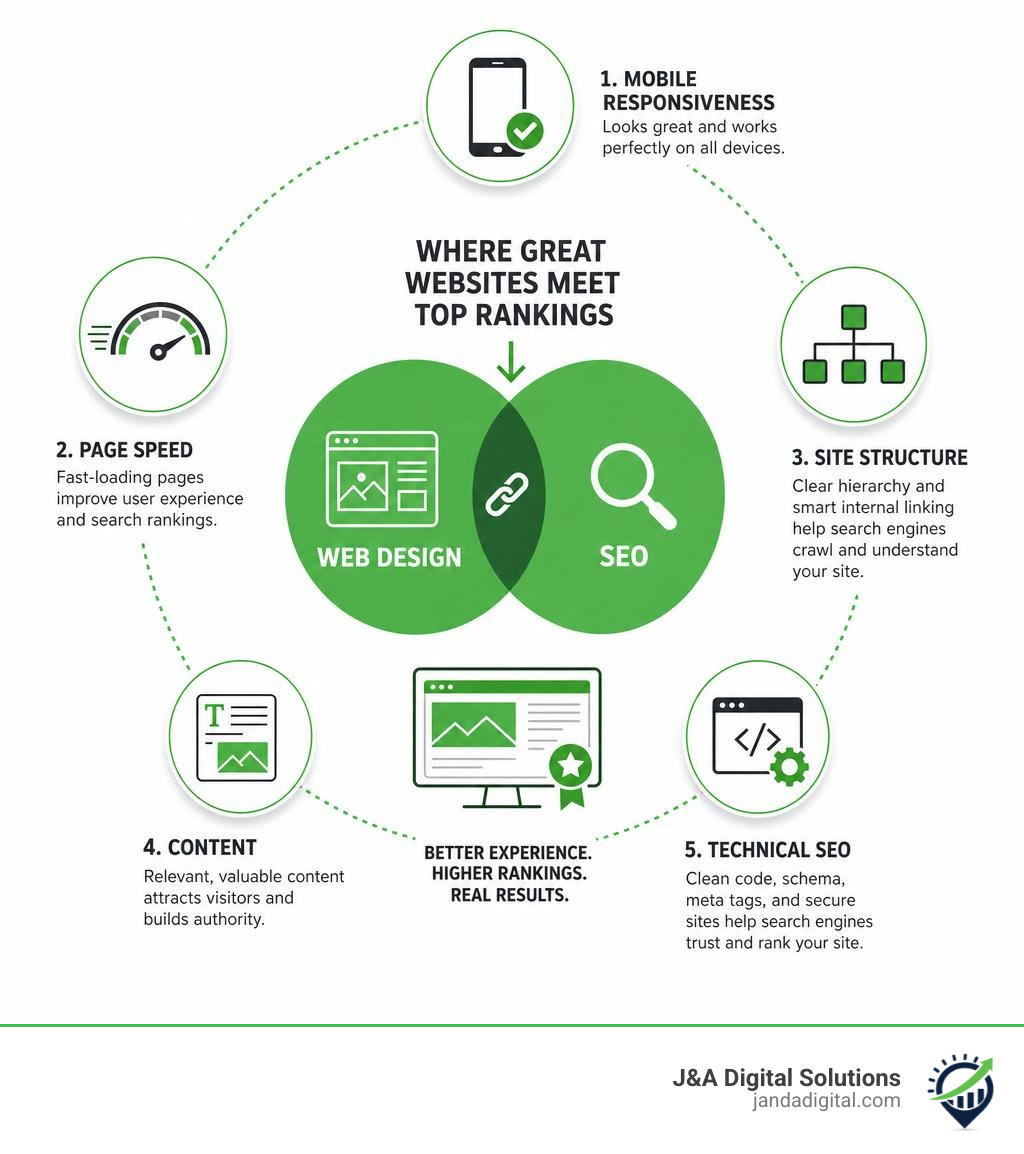
Seo web design services terms to remember:
What is SEO Web Design and Why Does It Matter?
When most people think of web design, they think of colors, fonts, layouts, and logos. They think about the visual “wow” factor. On the other hand, when they think of SEO, they think of keywords, blogs, and link building.
For years, these two fields operated in silos. A business would hire a graphic designer to build a beautiful website, and then—months after launch—hire an SEO specialist to “fix” it so it would show up on Google. This approach is like building a gorgeous house and then realizing you forgot to install plumbing or electrical wiring.
SEO web design is the practice of designing and building a website so that it is highly search-engine-friendly while simultaneously providing an exceptional user experience (UX). It ensures that search engines can easily crawl, index, and understand your website’s content, while human visitors can easily navigate, read, and convert.
Why is this combination so critical? Consider these facts:
- 92% of consumers land on a brand’s website with the intention to buy, research, compare offerings, or read online reviews. If your site isn’t visible during that research phase, you lose the customer before they even know you exist.
- 75% of site credibility comes directly from web page design. If your site looks like it was built in 2005, users will immediately hit the back button, signaling to Google that your site isn’t helpful.
- Search and design work in a continuous loop. SEO gets people to your site; design determines whether they stay, trust you, and buy.
To dive deeper into why a modern, functional digital footprint is non-negotiable for modern businesses, check out our guide on 7 reasons why you need a website.
Traditional Web Design vs. SEO-First Architecture
Traditional web design prioritizes aesthetics above all else. It is a “top-down” approach: make it look pretty first, then try to make it work. An SEO-first architecture is a “bottom-up” approach: build a structurally sound, highly crawlable foundation, and then wrap it in beautiful, functional design.
When a search engine bot (like Googlebot) visits your website, it doesn’t see the beautiful colors or custom animations. It sees code. If your code is bloated, your heading tags are disorganized, or your site structure is a maze, Google will struggle to index your pages.
An SEO-first design ensures:
- Logical Site Hierarchy: Organizing your pages in a clean, pyramid-style structure (e.g., Homepage -> Service Categories -> Individual Services).
- Crawlability: Ensuring there are no “orphan pages” (pages with no internal links pointing to them) and that search engines can easily navigate your entire site.
- Clean Code: Keeping HTML and CSS streamlined so search bots can read your content without getting bogged down in unnecessary scripts.
To understand how professional agencies map out these complex structures, read our In-depth guide to website design services.
The Business Value of Integrated SEO Web Design Services
Choosing integrated seo web design services is not just an aesthetic upgrade; it is a direct investment in your business’s bottom line. When search engine optimization and design are handled by the same cohesive team, you unlock massive competitive advantages:
- Lower Customer Acquisition Costs (CAC): Instead of constantly paying for clicks via Google Ads or social media ads, an SEO-optimized site brings in continuous, high-intent organic traffic for free.
- Higher Conversion Rates: A site engineered with search intent in mind aligns perfectly with what the user is looking for. When a user in Columbus searches for local services and lands on a page specifically designed to solve their exact problem with clear calls-to-action (CTAs), they convert.
- Protection Against Ranking Drops: Redesigning an existing website without an SEO-first strategy is one of the easiest ways to destroy your hard-earned search rankings. An integrated approach uses careful URL mapping and 301 redirects to preserve your search equity.
- Future-Proofing for AI Search: In 2026, search engines are increasingly driven by Large Language Models (LLMs) and AI Overviews. These systems pull answers from websites with clean, structured schema and clear content hierarchies. If your site isn’t built to be “AI-ready,” you will lose visibility.
For local business owners in our backyard—whether you are looking for Website Design Columbus Ohio or need a trusted partner for SEO in Columbus Ohio—this integration is what separates profitable websites from expensive digital brochures. Discover how this works in practice by reading how smart web redesign can transform local businesses.
Core Elements of High-Performing SEO Web Design Services
To build a website that ranks and converts, several multidisciplinary elements must work in perfect harmony.
Let’s look at how traditional web design practices compare directly to an SEO-friendly approach:
| Feature / Element | Traditional Web Design | SEO-Friendly Web Design |
|---|---|---|
| Primary Goal | Visual appeal and artistic expression | User conversion and search engine visibility |
| Mobile Approach | Desktop-first, scaled down for mobile | Mobile-first, fully responsive and touch-optimized |
| Site Structure | Creative, often unpredictable navigation | Logical, hierarchical pyramid structure |
| Images & Media | High-resolution, unoptimized files | WebP/AVIF formats, lazy-loaded with alt text |
| Code Base | Heavy visual builder scripts and bloat | Clean, semantic HTML and CSS |
| Content Strategy | Added after the design is finalized | Planned before design to match search intent |
Mobile Responsiveness and User Experience (UX)
We live in a mobile-first world. Mobile devices generate over 60% of global web traffic, reaching approximately 64% in 2025 and climbing even higher here in 2026. In the United States, smartphones account for around 70% of all digital media time, and mobile devices account for roughly 65% of all Google searches.
Because of this, Google uses mobile-first indexing. This means Google looks at the mobile version of your website as the primary version when determining your rankings. If your desktop site is perfect but your mobile site is slow, clunky, or hard to read, your rankings will plummet across all devices.
A truly responsive design dynamically adapts to any screen size—whether it is an iPhone, an Android tablet, or a massive desktop monitor. Key mobile UX considerations include:
- Touch-Friendly Targets: Buttons and links must be large enough and spaced far enough apart for human thumbs to click easily.
- Readable Typography: Font sizes must scale so users don’t have to pinch and zoom to read your services.
- Simplified Navigation: Hamburger menus and clean, accessible search bars make mobile browsing painless.
If you are a local business owner in Central Ohio, having a mobile-optimized site is critical for capturing on-the-go searches. Learn more about this local necessity in our guide on why Columbus businesses need better web design.
Page Speed, Core Web Vitals, and Performance Budgets
A beautiful website is completely useless if nobody waits for it to load. Studies show that 53% of mobile visitors will abandon a page if it takes longer than three seconds to load.
Google formalizes this user expectation through Core Web Vitals, a set of specific metrics that measure page speed, responsiveness, and visual stability:
- Largest Contentful Paint (LCP): Measures loading performance. To provide a good user experience, LCP should occur within 2.5 seconds of when the page first starts loading.
- Interaction to Next Paint (INP): Measures page responsiveness to user inputs (like clicking a button). A good INP score is 200 milliseconds or less.
- Cumulative Layout Shift (CLS): Measures visual stability. Have you ever tried to click a link on a mobile site, only for the page to shift suddenly and cause you to click an ad instead? That is a bad CLS. Your CLS score should be 0.1 or less.
To consistently hit these targets, professional seo web design services enforce a strict “performance budget” during the build. This includes compressing images into modern formats like WebP or AVIF, lazy loading off-screen media, minifying CSS and JavaScript, and utilizing reliable, high-performance hosting.
Find out what else your site needs to dominate the web in our article on 6 essential things websites must have to be successful.
Content Strategy and Copywriting Integration
A common mistake in traditional web design is using “Lorem Ipsum” placeholder text during the design phase, only to copy and paste generic text right before launch. This is backwards.
Content and design must be developed together. Your design should serve as a visual frame that guides the reader’s eye through your copy, leading them directly to your call-to-action.
From an SEO perspective, your content strategy must be built around search intent. What is the user looking for when they type a query into Google?
- Heading Hierarchy: Your pages must use a single H1 tag for the main title, followed by structured H2 and H3 tags for subtopics. This helps search engines understand the relationship between different sections of your content.
- Scannability: Online readers do not read word-for-word; they scan. Bullet points, short paragraphs, bold text, and visual callout boxes keep users engaged longer, reducing your bounce rate.
- Keyword Mapping: Each page on your site should target a primary keyword cluster without resorting to spammy “keyword stuffing.”
To learn more about aligning your words with Google’s algorithms, explore discover how high-quality content boosts Google ranking and our guide on elevating your website’s ranking with smart content marketing.
Technical SEO and Platform Considerations in Web Design
Beneath the surface of every high-performing website is a complex layer of technical optimization.
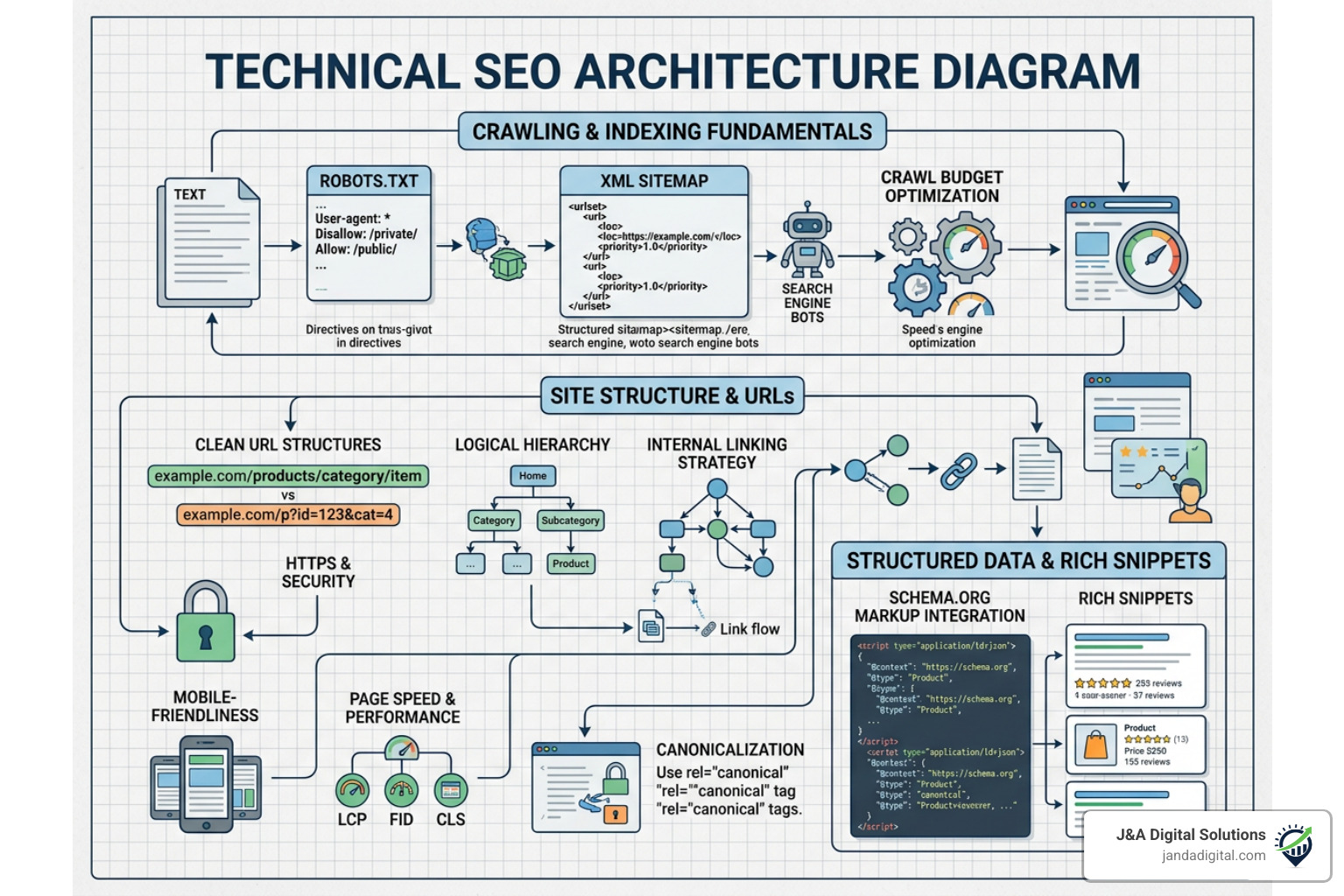
These technical foundations must be built directly into the site’s codebase during the design and development phases.
Technical Foundations: Schema, Meta Tags, and Site Structure
When search engine crawlers scan your site, they rely on specific technical signals to categorize your business and display your pages correctly in search results:
- Schema Markup (Structured Data): This is a specialized vocabulary of code added to your website that helps search engines understand exactly what your data means. For example, local schema tells Google your exact physical address, phone number, hours of operation, and customer reviews. This is critical for appearing in the highly coveted local “Map Pack.”
- Optimized URL Structures: Your URLs should be clean, logical, and descriptive (e.g.,
yoursite.com/services/seo-web-designinstead ofyoursite.com/page-id?12345). - XML Sitemaps and Robots.txt: An XML sitemap acts as a roadmap for search engines, listing all the pages on your site that need to be crawled. The robots.txt file tells search bots which parts of your site they shouldn’t crawl (like admin login pages).
- Meta Tags: Clean, custom meta titles and description tags must be configured for every page to maximize your click-through rates (CTR) on search engine results pages (SERPs).
If you are looking to work with top-tier agencies in the state, you can check out the Top SEO Companies in Ohio to see how local leaders implement these technical systems.
Choosing the Right CMS for Your SEO Web Design Services
Your Content Management System (CMS) is the engine under your website’s hood. Choosing the wrong platform can severely limit your SEO capabilities, slow down your load times, and make future updates a nightmare.
- WordPress: Powering approximately 43% of all websites globally, WordPress remains the undisputed king of CMS platforms. It offers unparalleled flexibility, a massive ecosystem of SEO plugins (like RankMath or Yoast), and excellent scalability.
- Shopify: For e-commerce businesses, Shopify is a robust, highly optimized platform out of the box, though it requires specialized design knowledge to customize URL structures and clean up theme code.
- Custom CMS or Headless Setups: For enterprise-level brands with highly specific functional needs, custom web development offers absolute control over performance, code cleanliness, and security.
No matter which platform fits your operational goals, the key is having an expert developer who knows how to configure it for search. To learn how to make the most of the world’s most popular platform, read our best guide on how to create a successful WordPress website and learn about elevating your brand with custom website development.
Frequently Asked Questions About SEO Web Design
What is the difference between web design and SEO web design?
Traditional web design focuses primarily on the visual aesthetics, user interface (UI), and creative layouts of a website. Its goal is to make the site look beautiful and represent the brand visually.
SEO web design services combine these visual elements with technical search engine optimization. An SEO web designer structures the site’s code, page hierarchy, URL formats, page speed, and mobile responsiveness so that search engines can easily crawl and index the site, ensuring that human visitors can actually find it in the first place.
Will a website redesign hurt my existing search rankings?
It can—if it is done incorrectly. When you change your website’s design, you often change your page URLs, site structure, and content. If you delete old pages that already rank on Google without setting up proper 301 redirects, search engines will crawl those old links, find broken “404 Error” pages, and drop your rankings immediately.
An experienced agency uses a meticulous migration strategy, mapping out every single old URL to its corresponding new page, ensuring you preserve your hard-earned domain authority and traffic.
How long does it take to build an SEO-optimized website?
A high-quality, custom SEO-optimized website typically takes anywhere from 6 to 12 weeks from start to finish. This timeline includes several critical phases:
- Discovery & Strategy: Researching your audience, competitors, and keywords.
- Architecture & Wireframing: Mapping out the page structure and user journeys.
- Design: Creating and refining the visual layouts.
- Development & Technical SEO: Coding the site, optimizing page speed, and implementing schema markup.
- Quality Assurance & Launch: Testing responsiveness, links, and speed before going live.
Conclusion
In 2026, a beautiful website that nobody can find is just an expensive digital paperweight. On the flip side, a highly ranked website that looks outdated and is hard to navigate will simply drive your hard-earned traffic straight into the arms of your competitors.
To win in today’s competitive online landscape, you must merge aesthetics with search power.
At J&A Digital Solutions, we specialize in helping small to medium-sized businesses in Columbus, Lancaster, and the surrounding Central Ohio areas dominate search results and generate consistent, high-quality local leads. We don’t just build pretty websites—we build conversion engines.
Because we believe so strongly in our proprietary lead generation systems, we offer an industry-leading “5 Lead Guarantee.” We take the risk out of your marketing investment by guaranteeing real, hot local leads that turn into paying customers.
Ready to stop losing local customers to your competitors? Elevate your business with professional website design services and check out our full suite of SEO Services to start dominating “near me” searches today.