

Broken Link Building: Effective 5-Step Guide
Why Your Backlink Profile Needs Regular Checkups
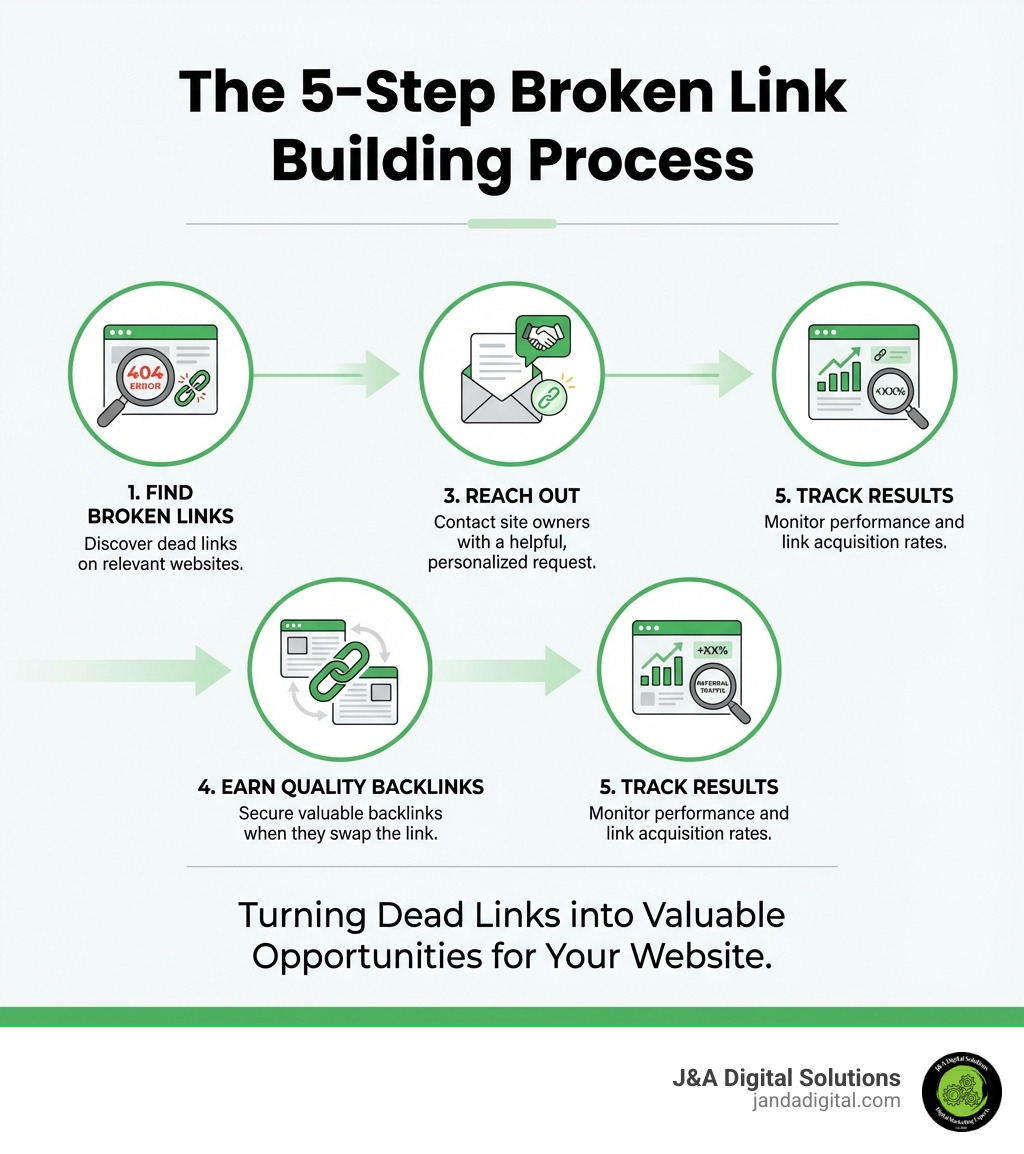
Broken link building is a white-hat SEO strategy where you find dead links (404 errors) on other websites, create or identify relevant replacement content, and reach out to site owners suggesting they swap the broken link for your working resource.
Quick Answer:
- Find broken links on relevant websites using tools like Ahrefs or Check My Links
- Create better content that matches or improves upon the original resource
- Reach out to site owners with a helpful, personalized email
- Earn quality backlinks when they replace the dead link with yours
- Track results through link acquisition rates and referral traffic
Here’s the reality: 44% of backlinks from the last seven years are dead or broken. That’s a massive opportunity sitting right in front of you.
Every broken link frustrates visitors, hurts user experience, and damages a site’s SEO. By helping fix these dead ends, you’re not just building links—you’re improving the internet while earning valuable backlinks for your business.
The beauty of this strategy is that site owners want to fix broken links. You’re not asking for a favor; you’re offering a solution to a problem on their site. This value-first approach leads to higher success rates than many other link building tactics.
But here’s what most local service businesses miss: broken link building isn’t just about finding any dead link. It’s about finding high-quality opportunities that match your business, create genuine value, and connect you with sites your ideal customers already visit.
I’m Josh Preece, and I’ve spent over 20 years helping businesses build stronger online presences through ethical SEO strategies like broken link building. At J&A Digital Solutions, I’ve developed proven systems that turn broken links into valuable backlinks for local service businesses across Ohio.
In this guide, I’ll walk you through exactly how to diagnose problems in your backlink profile, find high-quality broken link opportunities, and execute outreach that actually gets results.
Explore more about Broken link building:
What is Broken Link Building and Why is it Effective?
Broken link building is the process of finding links on other websites that lead to 404 “Page Not Found” errors. These dead ends frustrate users and are a red flag for search engines like Google, which recommends fixing them. This creates a clear opening for us to provide value.
When we find one of these digital dead ends, our goal is to create or find a superior piece of content on our own site that would be a perfect replacement for the missing resource. Then, we politely inform the website owner about their broken link and offer our content as a solution. It’s like being a digital good Samaritan, but with a fantastic SEO benefit!
Why is this approach so effective?
- It’s a Win-Win Situation: Website owners want to fix broken links. They hurt user experience and can signal poor site maintenance to search engines. By pointing out an issue and offering a high-quality solution, we’re genuinely helping them improve their site. This makes them much more receptive to our request than if we were just asking for a link out of the blue.
- Higher Success Rates: Because we’re solving a problem, broken link building can have a higher success rate than many other link building tactics. We’re not just begging for a link; we’re providing value. Even a 5–10% success rate can lead to dozens of quality links if we scale our efforts.
- White-Hat SEO: This is a completely ethical, “white-hat” SEO strategy. We’re not engaging in shady practices or trying to manipulate search engines. We’re improving the web, one fixed link at a time, and earning legitimate backlinks in return.
- Improved User Experience: By helping other sites remove broken links and replace them with valuable content, we contribute to a better online experience for everyone. This aligns perfectly with Google’s focus on quality and user satisfaction.
- Improved SEO Benefits: The primary benefit for us is acquiring high-quality backlinks. These backlinks act as “votes of confidence” from other reputable websites, signaling to search engines that our site is trustworthy and authoritative. This, in turn, can significantly improve our website’s search engine rankings and drive organic traffic. Backlinks are crucial for SEO success, and broken link building is an excellent way to build them ethically.
- Referral Traffic: Beyond SEO, a well-placed backlink can also send direct referral traffic to our site from interested users.
- Relationship Building: This process often opens the door to building genuine relationships with other website owners and editors in our niche. These connections can lead to future collaborations, guest posting opportunities, and more.
We know that 52.3% of digital marketers consider link-building the most challenging aspect of SEO. But with broken link building, we turn a challenge into an opportunity by focusing on mutual benefit.
For more insights into the importance of backlinks, check out our guide on Mastering Backlinks in 2023: Making it Simple.
Your Step-by-Step Guide to Finding High-Quality Link Opportunities
Now that we understand the “why,” let’s dive into the “how.” Finding those golden opportunities requires a bit of detective work and the right tools. We’re looking for broken links that, when replaced with our content, will provide maximum impact for our SEO efforts.

How to Find Broken Links on Websites
Finding broken links is the first crucial step in our broken link building adventure. There are several effective ways to uncover these digital potholes:
- Browser Extensions: For on-the-fly checking, extensions like Check My Links are incredibly handy. You install it, steer to a webpage, click the icon, and it quickly highlights all the broken links (404 pages) on that page. This is great for resource pages or articles in your niche.
- SEO Crawlers: Tools like Screaming Frog SEO Spider can crawl entire websites and identify broken links, both internal and external. This is perfect for a more comprehensive audit of a target site.
- Google Search Operators: We can use specific search queries to find pages that are likely to contain many external links, which often become broken over time. Try these in Google:
"your keyword" + inurl:resources"your keyword" + intitle:links"your keyword" + "helpful resources""your keyword" + "useful resources"
These operators help us find curated lists of links (resource pages) that are prime candidates for containing broken links.
- Wikipedia “Dead Link” Technique: Wikipedia is a treasure trove of information, and sometimes, its citations become outdated. We can search Google for
site:wikipedia.org "keyword" intext:"dead link". When we find an entry with a “dead link” tag, we can then use a backlink analysis tool (which we’ll discuss next) to see if other sites are also linking to that same broken resource.
How to Leverage Competitor Analysis for Broken Link Building
This is where we get a little strategic and, dare we say, a bit cheeky. Competitor analysis isn’t just about seeing what they’re doing right; it’s about finding where they (or their linked resources) have gone wrong.
- Identify Competitors’ Broken Backlinks: We can use powerful SEO tools like SEMrush or Ahrefs to analyze our competitors’ backlink profiles. These tools allow us to filter for broken pages (404 errors) on their indexed sites. What we’re looking for are pages that used to exist on a competitor’s site but are now gone, yet still have valuable backlinks pointing to them.
- “Stealing” Backlinks: Once we’ve identified a competitor’s broken page that has a good number of backlinks, we can then examine those backlinks. The sites linking to our competitor’s defunct page are excellent prospects for us. We can create a superior version of the content that was originally on the broken page and then reach out to those sites, offering our new, working content as a replacement. It’s a fantastic way to acquire backlinks that already exist and are relevant to our niche.
This technique is incredibly effective because we’re targeting websites that have already demonstrated a willingness to link to relevant content. For more on improving your site’s authority, explore our insights on Off-Page SEO Unveiled: Key to Your Superior Rankings.
How to Identify High-Quality Link Opportunities
Not all broken links are created equal. Our goal isn’t just to get any link; it’s to acquire high-quality links that will genuinely boost our SEO. This means we need to vet our prospects carefully.
When we’re looking at a broken link opportunity, we assess several factors:
- Domain Authority (DA) / Authority Score (AS): How authoritative is the website that has the broken link? Tools like Semrush’s Authority Score (AS) measure authoritativeness on a scale of 0-100. We want links from sites with a decent DA/AS, as these carry more weight with search engines.
- Page Authority (PA): Beyond the overall domain, how strong is the specific page containing the broken link? A high-PA page linking to us is a goldmine.
- Relevance: Is the website and the specific page topically relevant to our business? A link from a local business directory in Columbus, Ohio, to our SEO services page is highly relevant. A link from a random blog about cat memes, while potentially high-DA, might not be as valuable for our specific goals in Lancaster, Ohio.
- Traffic Metrics: Does the page with the broken link receive significant organic traffic? A link from a popular page is more likely to send us referral traffic and pass more “link juice.”
- Link Context: How is the broken link positioned within the content? Is it a natural, editorial link within a paragraph, or is it buried in a footer? Editorial links are generally more valuable.
- Original Content Intent: To understand what kind of replacement content we need, we often need to see what the broken page used to look like. The Wayback Machine is our time-traveling friend here. We can plug the dead URL into the Wayback Machine and see archived versions of the page. This helps us understand the original topic, format, and depth, ensuring our replacement content is a perfect fit.
By carefully vetting our prospects, we ensure that our efforts are focused on opportunities that will yield the most significant results for our SEO. This meticulous approach to link building complements our broader On-Page SEO Mastery: Your Key to 2023 Success Strategies.
Mastering the Art of Outreach and Communication
Finding the perfect broken link opportunity is only half the battle. The other, equally important half, is mastering the art of outreach – convincing the website owner to replace their broken link with ours. This is where our communication skills truly shine.
What Makes a Good Replacement Resource for a Broken Link?
Before we even think about sending an email, we need to ensure we have a compelling replacement resource. This isn’t just about having any content; it’s about having content that is genuinely better than what was there before.
A good replacement resource should:
- Match User Intent: Thanks to the Wayback Machine, we know what the original broken page was about. Our replacement must address the same topic and answer the same questions the original content aimed to. If the original was a guide on “how to choose an HVAC system,” our content should be a comprehensive, up-to-date guide on that exact topic.
- Improve on the Original: This is crucial. We don’t just want to replicate; we want to lift. Our content should be:
- More Up-to-Date: Information gets old fast. Our content should reflect the latest trends, statistics, or best practices.
- More In-Depth: If the original was a short article, our replacement could be a detailed guide or an ultimate resource.
- Better Visuals: Infographics, custom images, charts, and videos can make our content more engaging and easier to understand.
- Better Structured: Clear headings, bullet points, and a logical flow improve readability.
- More Value-Driven: Offer a downloadable checklist, a free template, or unique insights that weren’t present in the original.
- Be Relevant to Our Business: The replacement content must naturally align with our services or expertise. If we offer local SEO services in Columbus, Ohio, our replacement content should be related to local SEO, digital marketing, or website optimization, not, say, gourmet cooking.
We want the website owner to look at our suggested replacement and think, “Wow, this is actually better than what we had, and it solves our broken link problem!” Our commitment to superior content is outlined further in The power of superior content in digital marketing.
How to Craft an Outreach Email for Broken Link Building
This is our moment to shine! A well-crafted email can turn a broken link into a valuable backlink. We’re being helpful, not demanding.
Here are the key best practices for outreach emails:
- Personalization is Key: Generic emails get ignored. Always address the recipient by their name (if you can find it) and mention their website or a specific piece of their content. A personalized greeting shows we’ve done our homework.
- Clear, Concise Subject Line: Busy webmasters don’t have time for vague emails. Something like “Quick question about your site” or “Heads up: Broken link on your site” works well.
- Value-First Approach: Lead with the problem you’ve identified and the solution you’re offering. Don’t immediately ask for a link.
- Friendly and Professional Tone: Keep it warm, polite, and respectful. Avoid any language that sounds demanding or pushy.
- Be Concise: Get straight to the point. Webmasters are busy, so respect their time.
Here is a breakdown of the key components every outreach email should include:
- Personalized Greeting: Address the recipient by name if possible.
- The Broken Link Location: Briefly explain where you found the broken link (page URL and context).
- Your Replacement Suggestion: Share a specific, relevant URL on your site that can serve as a better, up-to-date resource.
- The Value Add: Explain why your resource helps their readers and improves their page.
Here’s an example of a personalized email in action:
Subject: Broken Link on Your “Local Business Growth” Page
Hi Sarah,
I hope this email finds you well!
I was recently browsing your insightful article, “Strategies for Local Business Growth,” on your site and found it incredibly useful, especially your points on community involvement.
While reading, I noticed a small issue: there’s a broken link in your “Resources” section. The link to an old SEO guide seems to be leading to a 404 error.
Since your article is about local growth, I thought my comprehensive guide on Off-Page SEO might be a perfect, up-to-date replacement for your readers. You can find it here: https://jandadigital.com/off-page-seo-guide/. It covers modern strategies for building local authority that your audience would find valuable.
No worries if it’s not a fit, but I thought you’d appreciate the heads-up about the broken link!
Thanks for your time,
Josh Preece
J&A Digital Solutions
This approach is similar to the successful strategies discussed in Advanced SEO Strategy That Gets Results.
Best Practices for Conducting Outreach
Our outreach strategy needs to be as refined as our content. Here’s how we maximize our chances of success:
- Finding the Right Contact: Sending an email to a generic “info@” address is like throwing a message in a bottle. We need to find the person who can actually make the change. We look for:
- Author Bylines: If the article has an author, that’s our first target.
- Editor/Webmaster: Check the “About Us,” “Contact Us,” or “Team” pages. Look for roles like “Editor,” “Content Manager,” or “Webmaster.”
- Social Media/LinkedIn: Sometimes, a quick search on LinkedIn or Twitter can reveal the right person. Tools like Hunter.io can also help find email addresses associated with a domain.
- Follow-Up Strategy: Most people are busy. A single email often gets lost in the shuffle. We typically send 1-2 polite follow-ups, spaced about a week apart. Each follow-up should add a little value or a gentle reminder, but we never badger. If we don’t hear back after two follow-ups, it’s time to move on.
- Sniper vs. Shotgun Outreach:
- Shotgun (Mass Outreach): Sending a largely identical email to hundreds or thousands of prospects. This is generally discouraged as it’s often perceived as spammy and yields low results.
- Sniper (Targeted Outreach): Highly personalized emails sent to a carefully selected, small number of prospects. This requires more effort per email but yields much higher success rates because the message is highly relevant and personal.
- Our Approach (Hybrid): We advocate for a hybrid approach. We use tools to identify a larger pool of potential broken links and contacts, but then we personalize each email significantly. We segment our prospects based on their relevance and the context of their broken link, then use custom templates that we customize for each individual. This balances efficiency with personalization, maximizing our chances of success.
- Avoiding Spammy Tactics: We never use misleading subject lines, irrelevant content, or overly aggressive follow-ups. Our reputation is paramount, and we want to build genuine connections, not just acquire links. We also avoid pitching abandoned sites or ones that clearly haven’t been updated in years, as our efforts would likely be wasted.
Measuring Success and Comparing Strategies
After all our hard work, how do we know if our broken link building efforts are paying off? And how does this strategy stack up against other ways to build links? Let’s break it down.
How Can You Measure the Success of Your Broken Link Building Efforts?
Measuring success is crucial for understanding our return on investment and refining our strategy. We look at several key metrics:
- Link Acquisition Rate: This is the most direct measure. How many new backlinks did we acquire compared to the number of outreach emails sent? Even a 5-10% success rate can be excellent, especially when dealing with high-authority domains.
- Response Rate: How many people replied to our emails, even if they didn’t grant a link? A good response rate indicates our outreach is compelling and reaching the right people.
- Referral Traffic: Once a link is live, we monitor our analytics to see if it’s sending direct traffic to our site. This indicates that the link is not only good for SEO but also for direct user acquisition. We can track this using Google Analytics.
- Keyword Ranking Improvements: The goal of backlinks is to improve our search engine rankings. We track the ranking of our target keywords in tools like Google Search Console to see if our efforts are contributing to higher visibility.
- Domain Authority/Authority Score Growth: Over time, a successful broken link building campaign should contribute to an increase in our website’s overall authority metrics.
By consistently tracking these metrics, we gain valuable insights into what’s working and where we can improve our strategy. For a deeper dive into marketing metrics, check out our Professional Insights on Effective Marketing Metrics for SEO.
Potential Risks and Challenges
While broken link building is a highly effective strategy, it’s not without its problems. Being aware of these challenges helps us prepare and adjust our expectations:
- Time-Consuming: Identifying broken links, vetting opportunities, creating content, finding contacts, and sending personalized emails—all of this takes time and effort. It’s not a “set it and forget it” strategy.
- Low Success Rates (Individual Links): While the overall strategy can have a high success rate, individual emails won’t always lead to a link. Many webmasters are busy, and some simply won’t reply. It’s a numbers game, and persistence is key.
- Being Ignored: Despite our best efforts at personalization, some emails will inevitably go unanswered. It’s important not to get discouraged.
- Scalability Issues: While tools can help automate parts of the process, the most effective broken link building often requires a human touch for personalization and content creation, which can limit how quickly we can scale.
- Finding Relevant Opportunities: Depending on our niche, finding a consistent stream of high-quality, relevant broken link opportunities can be challenging. It requires ongoing research and creativity.
- Google’s Recommendations: Google itself notes that broken links can negatively impact user experience and recommends fixing them. This is a challenge for other websites but an opportunity for us, as it gives us a strong reason for outreach.
How Does Broken Link Building Compare to Other Link Building Strategies?
It’s helpful to understand how broken link building stacks up against other common link building tactics. Each strategy has its pros and cons, and a well-rounded SEO approach often incorporates several.
| Strategy | Effort Level (1-5) | Success Rate (Low/Med/High) | Scalability (Low/Med/High) | Key Benefit |
|---|---|---|---|---|
| Broken Link Building | 3 | Medium-High | Medium | Acquiring links from already-linking sites, providing value to webmasters, white-hat. |
| Guest Blogging | 4 | Medium | Medium | Direct control over anchor text, brand exposure, builds relationships. |
| Content Marketing | 5 | Medium-High | High | Attracts natural links over time, builds authority, drives organic traffic (requires exceptional content). |
| Skyscraper Technique | 4 | Medium | Low-Medium | Targets high-value links, requires superior content creation. |
| Resource Page Links | 2 | Medium | Medium | Easier to find prospects, often lower barrier to entry. |
| PR & Media Outreach | 5 | Low-Medium | Low | High-authority links, significant brand exposure, referral traffic. |
Broken link building stands out because it leverages a problem (broken links) into a solution, creating a compelling reason for webmasters to link to us. This often leads to a higher success rate compared to cold outreach for guest posts or content promotion, where the recipient might not immediately see the benefit.
While content marketing is crucial for attracting natural links and building authority (and we’re big fans of it, as you can see in Elevate your websites ranking with smart content marketing), broken link building offers a more direct and proactive way to acquire specific backlinks from targeted, relevant sites. It’s an excellent complement to a robust content strategy.
Conclusion: Revitalize Your Backlink Profile
We’ve journeyed through the intricacies of broken link building, from understanding its fundamental effectiveness to mastering the art of finding opportunities and crafting compelling outreach. We’ve seen how this ethical, value-driven strategy can transform a frustrating 404 error into a powerful backlink, enhancing your website’s authority, driving referral traffic, and ultimately boosting your search engine rankings.
By actively helping other website owners improve their sites, we’re not just playing the SEO game; we’re making the internet a better, more functional place. This strategy is a testament to the idea that by giving first, we often receive the most valuable rewards. It’s a long-term play, building genuine relationships and a robust, resilient backlink profile that stands the test of time.
For businesses seeking a hands-off approach to dominate local search and secure high-quality backlinks, J&A Digital Solutions offers expert SEO Services to handle the entire process for you. Whether you’re a small business in Lancaster, Ohio, or looking to expand your reach in Columbus, Ohio, our proprietary lead generation system ensures you’re not just found, but chosen. Let us be your link doctors, diagnosing and repairing your backlink profile for sustained online success.