

Pinpoint Your Audience: The Power of Geotargeted Marketing
Why Geo-Targeted Marketing Matters for Local Businesses
Geo-targeted marketing is a digital advertising strategy that delivers personalized content and ads to potential customers based on their physical location—whether that’s a specific country, state, city, ZIP code, or even a radius around your business.
Quick Overview: What Geo-Targeted Marketing Offers
- Precision: Target customers within 1–25 miles of your service area
- Technologies Used: IP addresses, GPS data, Wi-Fi signals, and device tracking
- Common Methods: Radius targeting, ZIP code targeting, city/state targeting, and geofencing
- Key Benefits: Higher relevance, better engagement, lower ad costs, and increased foot traffic
- Platforms: Google Ads, Facebook, Instagram, and specialized geotargeting tools
For local service businesses, this means you can stop wasting ad dollars on people outside your service area and start focusing every marketing dollar on the neighbors most likely to call you.
The numbers tell the story. 88% of local searches result in a phone call or physical visit within 24 hours. When someone searches for “plumber near me” or “HVAC repair,” they’re ready to buy right now—and they want someone close by. Geo-targeted marketing puts your business in front of these high-intent customers at exactly the right moment.
Traditional advertising casts a wide net and hopes for the best. Geo-targeted marketing uses a spear instead. You define your service area down to the ZIP code or even street level, then serve ads only to people in that zone. No more paying to advertise to someone three states away who will never become a customer.
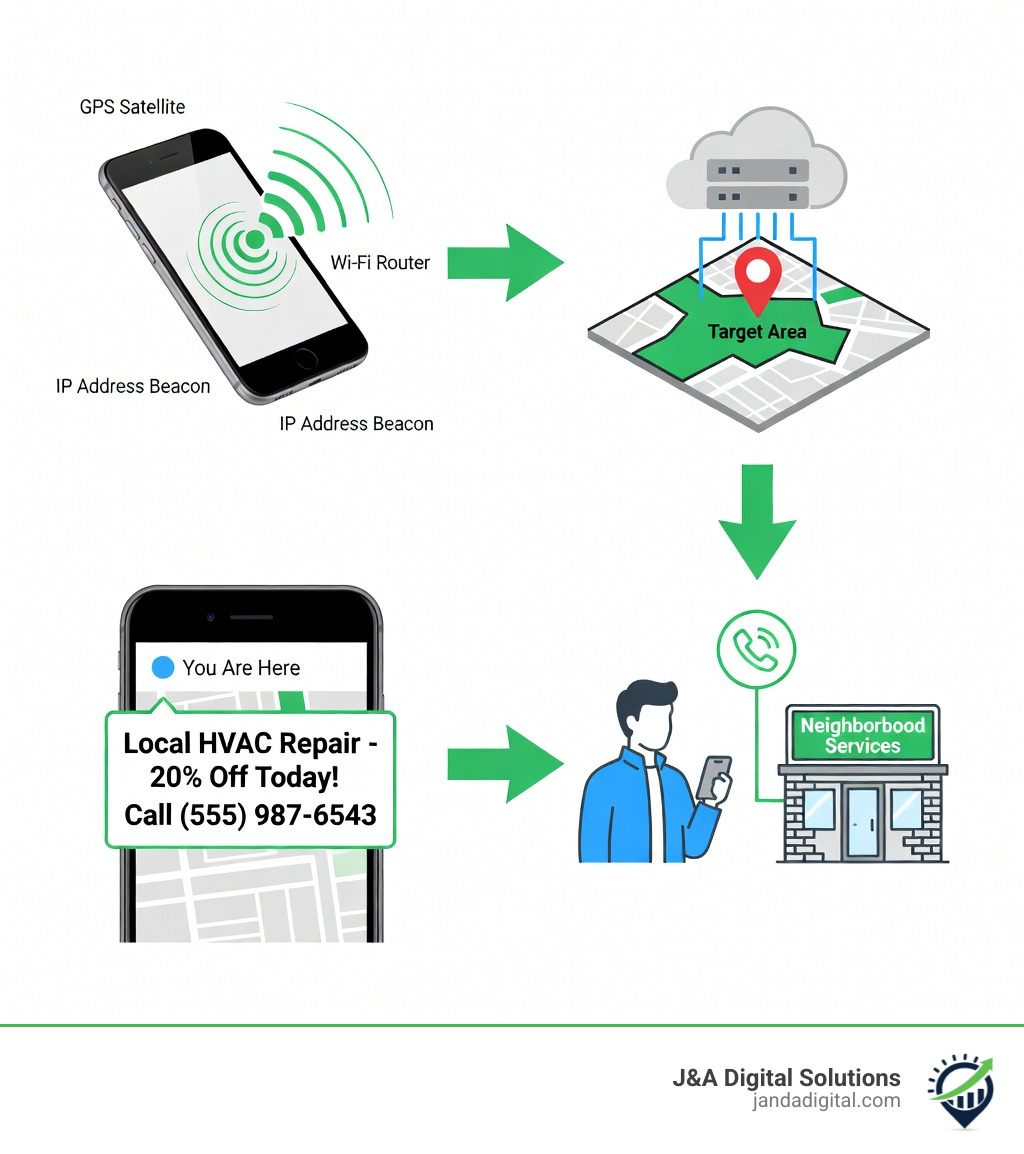
The technology works quietly in the background. When someone in your target area searches on their phone, browses social media, or visits a website, your ad appears because the platform knows their location through GPS, IP address, or Wi-Fi signals. This isn’t futuristic—it’s happening millions of times every day, and your competitors are already using it.
For contractors, home service providers, and local businesses, geo-targeted marketing solves a critical problem: how to generate consistent, qualified leads from your immediate service area without wasting money on irrelevant traffic. It’s the difference between shouting into the void and having a conversation with your ideal customer.
I’m Josh Preece, founder of J&A Digital Solutions, and over the past 20+ years I’ve helped local service businesses across Ohio leverage geo-targeted marketing to dominate their service areas and generate predictable lead flow. My team and I use geo-targeted marketing strategies daily to help contractors and service providers connect with customers who are actively searching in their local area.
Simple guide to geo-targeted marketing:
What is Geo-Targeted Marketing and How Does It Work?
At its core, geo-targeted marketing is about delivering the right message to the right person based on where they are standing (or sitting). It bridges the gap between the physical world and the digital one. But how does your smartphone or laptop actually know you’re in downtown Columbus or a quiet neighborhood in Lancaster?
It all comes down to data signals. There are several ways platforms identify a user’s location:
- IP Addresses: Every internet connection has a unique IP address. While it doesn’t always pinpoint a specific house, it can accurately identify the city or ZIP code.
- GPS Data: This is the gold standard for mobile devices. It uses satellite signals to provide pinpoint accuracy, often within a few meters.
- Wi-Fi Signals: If you’re connected to a public Wi-Fi network at a coffee shop in Columbus, the system knows exactly where that router is located.
- Cellular Data: Cell towers can triangulate a user’s position based on signal strength.
By combining these signals, we can ensure that your ads for “emergency AC repair” only show up for people in your actual service area. This is a massive component of local SEO, as it ensures your business appears in the “Map Pack” and local search results when it matters most.
Geotargeting vs. Geofencing
While people often use these terms interchangeably, they are actually different tools in our marketing shed.
- Geotargeting is broad and strategic. It delivers ads to people in a specific geographic area who also meet certain criteria, like interests or behaviors. For example, we might target “homeowners in Lancaster who are interested in landscaping.”
- Geofencing is more about “drawing a line in the sand.” It creates a virtual boundary around a specific location. When a user enters that boundary, it triggers a real-time action, like a push notification or a mobile ad.
Think of geotargeting as a neighborhood-wide flyer and geofencing as a digital greeter standing at your competitor’s front door. Geofencing is incredibly powerful for driving foot traffic, but geotargeting allows for deeper audience segmentation and behavioral filters.
The Role of IP Spidering and Geolocation
To make this all work, specialized software uses “IP spidering.” This is similar to how Google “crawls” the web to find new pages. In this case, the software analyzes the vast space of IPv4 addresses to map them to physical locations.
This process involves traceroute analysis (measuring the time it takes for data to travel) and looking at ISP (Internet Service Provider) data. While Google’s stance on IP addresses is that they aren’t “personal” information, they are incredibly useful for database mapping. Advanced systems can even detect when someone is using a proxy or VPN to fake their location, helping us avoid wasting your budget on “clicks” that aren’t actually in Ohio.
Core Methods and Types of Geolocation Targeting
Not every local business needs the same level of precision. A plumber serving all of Fairfield County needs a different setup than a bakery in downtown Columbus. Here is how we break down the different targeting types:
| Targeting Level | Best For… | Example |
|---|---|---|
| Country/State | Large brands or digital services | All of Ohio |
| City/Region | Businesses with multiple locations | Columbus, OH |
| ZIP Code | Hyperlocal service providers | 43130 (Lancaster) |
| Radius | Driving foot traffic or local calls | 10 miles around your shop |
| DMA | TV and large-scale digital buys | Columbus DMA |
Using these levels, we can create local marketing campaigns that are as broad or as narrow as your business needs.
Strategic Radius and Proximity Targeting
Radius targeting is a favorite for our clients in the home services industry. Instead of picking a whole city, you can set a “pin” on your office and target a 15-mile circle. This ensures your technicians aren’t spending half their day driving across the state.
This is also great for “proximity marketing.” If there is a large home-and-garden show happening at the Ohio Expo Center, we can set a small radius around that event to target people who are clearly interested in home improvement. This hyperlocal precision helps small businesses compete with national chains by dominating specific neighborhood clusters. It’s a core part of effective SEO for small business.
Keyword and Search-Based Intent
The magic happens when we combine location with intent. When someone in Columbus searches for “roofing contractor,” they aren’t just looking for information; they have a problem they need solved.
In Google Ads, we use “Presence” vs. “Interest” settings.
- Presence: Only shows ads to people physically located in your area.
- Interest: Shows ads to people searching about your area (e.g., someone in Cleveland searching for “Columbus movers” because they are planning a move).
By mastering these settings, we maximize search engine visibility and ensure your local SEO pricing reflects a high return on investment.
Key Benefits of Location-Based Strategies
Why should you care about geo-targeted marketing? Because it works better than almost any other form of digital advertising.
- 95% of marketers say personalization strategies are effective.
- 88% of local searches end in a phone call or visit within 24 hours.
- 75% of retailers reported a sales increase of at least 5% from location-based strategies.
- 83% improvement in campaign effectiveness when using location data.
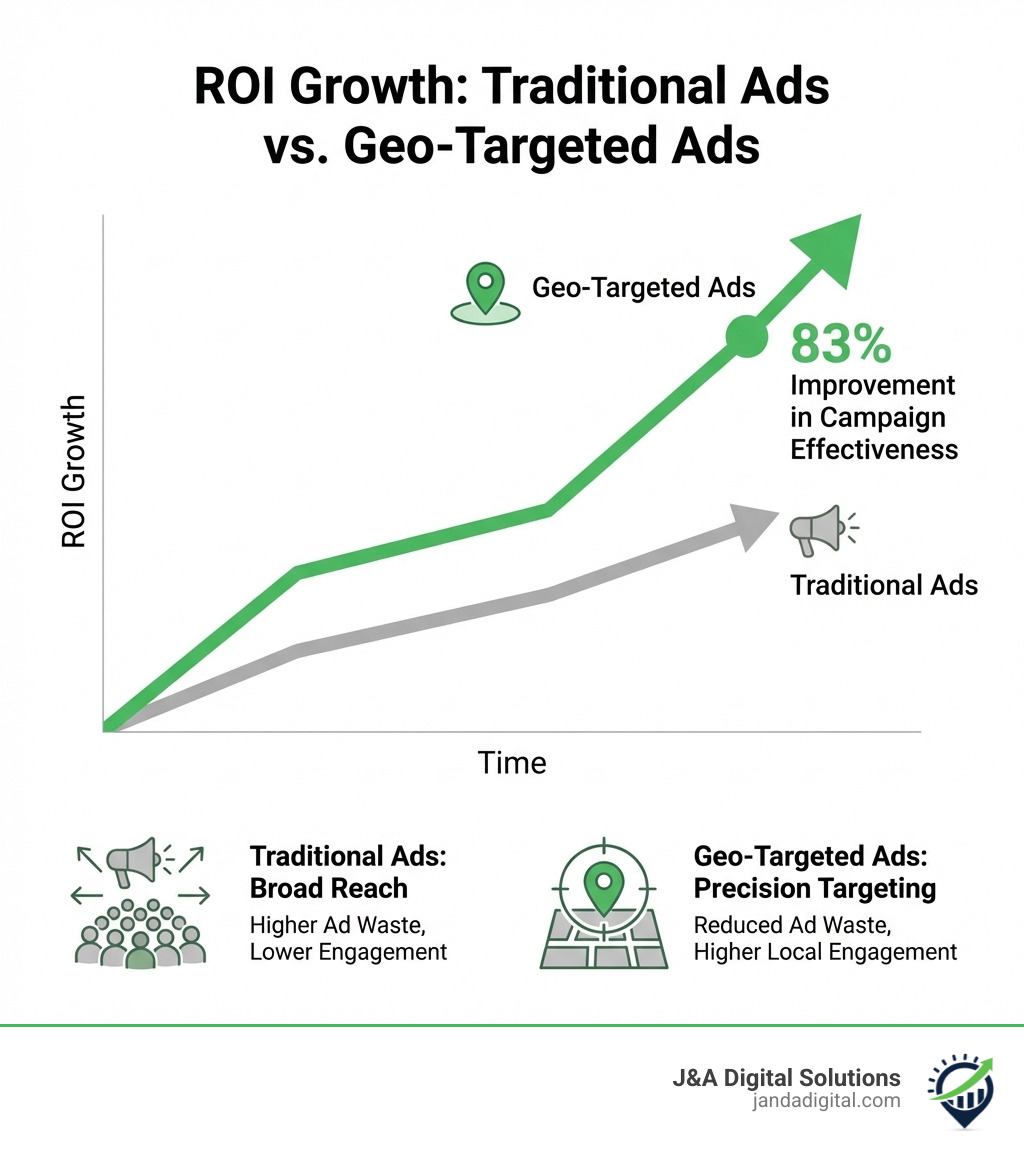
When you target locally, you reduce ad waste. You aren’t paying for clicks from people you can’t serve. This creates a massive competitive advantage. In a small town or a specific suburb, being the “neighborhood expert” is more valuable than being a giant national brand. This is why SEO is important in a small town—it builds trust and familiarity before the customer even picks up the phone.
Setting Up Your First Campaign
Setting up a geo-targeted marketing campaign might seem daunting, but platforms like Google and Facebook have made the basic tools very accessible.
- Platform Selection: Choose where your customers hang out. For emergency services, Google Ads is king. For lifestyle or home aesthetic services, Facebook and Instagram are great.
- Parameter Setup: Don’t just “target Columbus.” Look at your sales data. Which ZIP codes are your most profitable? Target those specifically.
- Creative Localization: Your ad shouldn’t look generic. Use local landmarks or mention the neighborhood by name. “Lancaster’s #1 Rated Electrician” performs much better than “Top Rated Electrician.”
- Performance Monitoring: Track everything. If you see a lot of clicks from one area but no calls, it’s time to adjust your boundaries.
Best Practices for Geo-Targeted Marketing
To get the most out of your budget, follow these local SEO secrets:
- Audience Research: Know the demographics of the neighborhoods you’re targeting. An affluent suburb in Columbus might need a different message than a rural area outside Lancaster.
- Mobile Optimization: Most local searches happen on a phone. If your website takes 10 seconds to load or looks “wonky” on a screen, you’ve lost the lead.
- Timing is Everything: If you’re a plumber, your ads should be most active during business hours—or 24/7 if you offer emergency service.
- CTA Localization: Instead of “Contact Us,” try “Call our Columbus Office Today.”
Common Mistakes in Geo-Targeted Marketing
Even the pros make mistakes. Here are the big ones to avoid:
- Over-Segmentation: If you target only three streets, your audience might be too small for the ad platform to serve your ads effectively.
- Ignoring Mobile Users: 81% of Americans own a smartphone. If your ads aren’t mobile-friendly, you’re missing 80% of the market.
- Ad Fatigue: If you show the same ad to the same small neighborhood 50 times, they’ll start to ignore you (or get annoyed).
- Neglecting Privacy: Always be transparent and follow data regulations.
Advanced Tactics and Privacy Considerations
Once you’ve mastered the basics, you can try “advanced” geo-targeted marketing.
- Weather-Based Triggers: Imagine your HVAC ad automatically increasing its bid when the temperature in Columbus hits 90 degrees. That’s possible with weather-based geotargeting.
- Geo-Conquesting: This is the “Burger King” tactic. You set a geofence around your competitor’s location and offer a special “switch to us” discount to anyone who enters that area.
- Indoor Mapping and Beacons: Used in large venues like malls or airports to send hyper-specific offers to people standing near a certain shop.
Of course, with great power comes great responsibility. Privacy concerns on the web are at an all-time high. While the US doesn’t have a single federal law like the GDPR, we must respect user privacy and provide opt-in controls where necessary. Being transparent about how you use data builds trust with your local customers.
Frequently Asked Questions about Geotargeting
How accurate is geotargeting for mobile users?
It’s incredibly accurate. GPS can locate a user within a few feet. However, in dense urban areas like downtown Columbus, tall buildings can sometimes interfere with satellite signals, forcing the device to rely on Wi-Fi or cell tower data, which is slightly less precise but still effective for city-level targeting.
Can I combine geotargeting with other targeting methods?
Absolutely! In fact, that’s where the best results come from. We often combine location with demographics (like age or homeownership) and behaviors (like “recently searched for home renovation”) to create a “hyper-qualified” lead profile.
How does geotargeting help with GDPR compliance?
For businesses that operate internationally, geotargeting allows you to show specific privacy consent boxes only to users in the EU, ensuring you meet their strict legal requirements without cluttering the experience for your local Ohio customers.
Conclusion
At J&A Digital Solutions, we don’t believe in “spray and pray” marketing. We specialize in generating guaranteed hot local leads for small to medium-sized businesses in Columbus and Lancaster. Our proprietary lead generation system is designed to help you dominate “near me” searches and build a fortress around your service area.
We are so confident in our strategies that we offer a “5 Lead Guarantee.” We deliver real customers to your door without the risk of traditional, unproven advertising. If you’re ready to stop chasing leads and start dominating your local market, we’re here to help.