

Local Competitor Analysis: 5-Step Secret Weapon
Why Local Competitor Analysis is Critical for Your Business Success
Local competitor analysis is the process of researching and evaluating businesses in your service area that compete for the same customers you’re targeting. It helps you understand what’s working in your market, where your rivals are falling short, and how you can position your business to win more local customers.
Here’s what local competitor analysis reveals:
- Who your real competitors are – both online and offline
- What makes customers choose them over other options
- Where they’re strongest – and where they’re vulnerable
- How to differentiate your business in ways that matter
- Opportunities they’re missing that you can capture
With over 33 million small businesses in the US, standing out locally isn’t optional. Every day, potential customers in your service area search for businesses like yours. If you don’t know what competitors are doing to capture those searches, you’re flying blind.
The good news is that most local businesses don’t do this. They guess at what might work, creating a massive opportunity for those who take the time to understand their competitive landscape.
This analysis reduces risk by showing you what strategies work in your area. It reveals market gaps and helps you avoid wasting money on ineffective tactics.
For local service businesses especially, ranking high on Google Maps is critical. Google Business Profile generates about 75% of qualified leads for most local businesses. Understanding how your competitors optimize their presence on these platforms gives you a clear roadmap for improvement.
I’m Josh Preece, founder of J&A Digital Solutions, and over the past 20+ years I’ve helped local service businesses use local competitor analysis to identify exactly what’s driving leads in their market. This guide will walk you through a practical, step-by-step process you can start using today.
What is Local Competitor Analysis and Why It’s Your Secret Weapon
Local competitor analysis is the process of gathering and evaluating information about your rivals in a specific geographic area. It’s about understanding their business models, marketing, and offerings in your backyard—whether that’s Columbus, OH, or Lancaster, OH. This isn’t about jealousy; it’s about making smarter business decisions.
Why is this so important for our local success? For local businesses, ranking high on Google Maps is not just nice to have; it’s highly critical. Imagine a customer in Columbus searching for “plumber near me.” If our business isn’t among the top results, we’re essentially invisible. Google Business Profile (GBP) generates around 75% of qualified leads for many local businesses, delivering fast results with a high ROI. This means our visibility in local search directly impacts our bottom line.
A comprehensive local competitor analysis isn’t just a best practice; it’s a necessity for thriving in today’s competitive landscape. It helps us:
- Understand our market position: By seeing what others are doing, we can pinpoint where we stand in the local market. Are we a premium service provider or a budget-friendly option? What’s our unique value proposition?
- Drive qualified leads: When we understand our competitors’ strengths and weaknesses, we can fine-tune our own strategies to capture more of those highly coveted “near me” searches, leading directly to more local leads.
- Identify market gaps: Competitors might be overlooking specific customer needs or underserved neighborhoods in Columbus or Lancaster. Our analysis can uncover these opportunities, allowing us to step in and fill the void.
- Improve our own strategies: We can learn from their successes and, perhaps more importantly, their failures. This allows us to adapt and improve our product, marketing, and sales strategies, often without having to reinvent the wheel.
Now, let’s clarify a common point of confusion: the difference between market analysis and competitor analysis. A market analysis takes a broad view of the entire industry, including its size, trends, and consumer behavior. It describes the playing field. In contrast, a competitor analysis zooms in on specific rivals, understanding their strategies and impact. Both are vital, but for a local edge, competitor analysis is our sharpest tool.
Your Step-by-Step Guide to a Winning Local Competitor Analysis
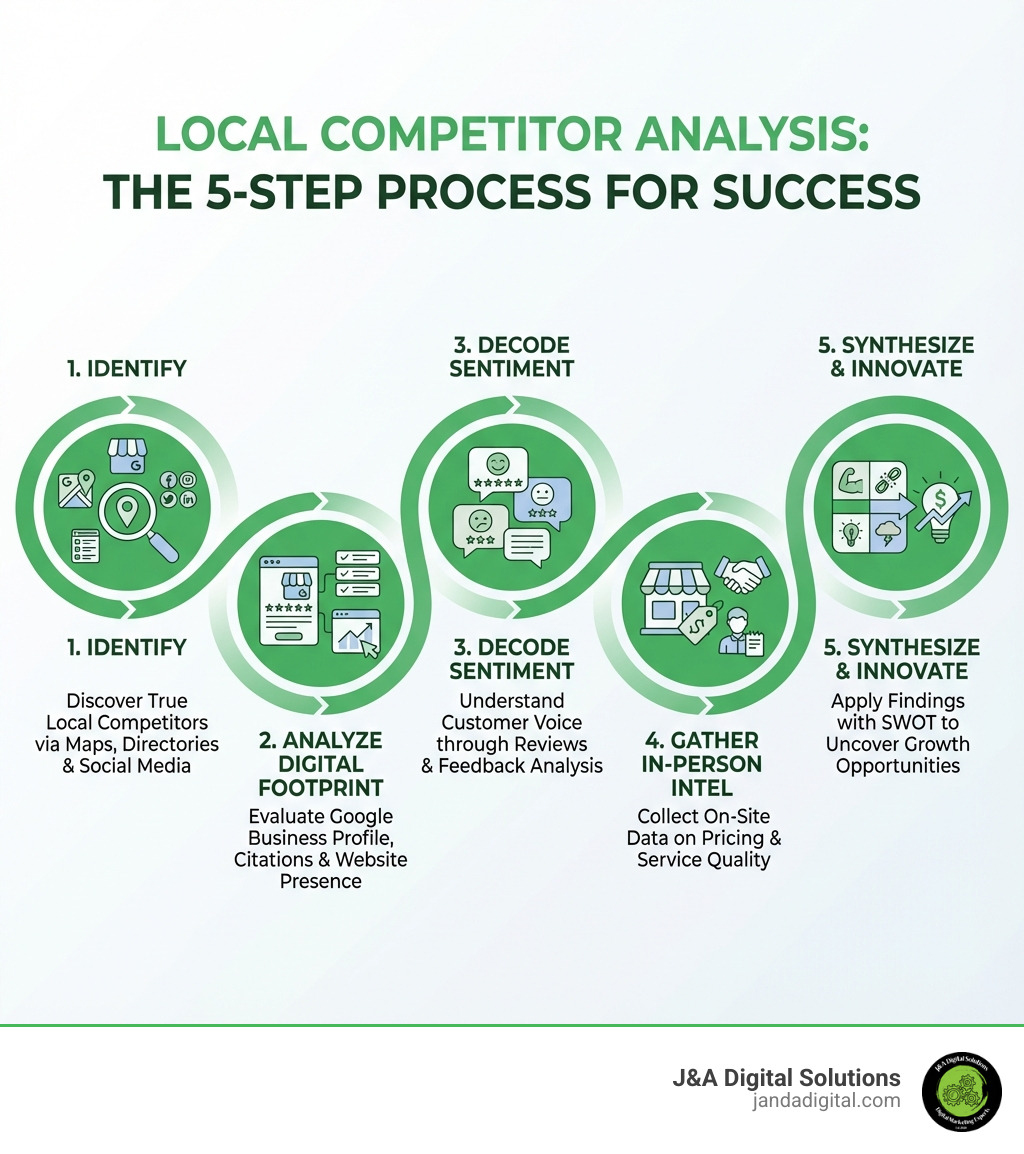
Here’s a practical, step-by-step guide to conducting a thorough local competitor analysis to gain the insights needed to outsmart the competition.

Step 1: Identify Your True Local Competitors
Identifying your true local competitors can be tricky. It’s not just about who offers similar services, but who is vying for the same customers in your service areas, like Columbus, OH, and Lancaster, OH.
- Direct competitors: These are the businesses offering the exact same products or services to the same target audience within our geographic footprint. For example, another plumbing company in Columbus directly competes for your customers.
- Indirect competitors: These businesses might offer a different product or service but address the same core customer need. A local handyman might be an indirect competitor to a plumber, as both solve home repair problems.
- Online vs. offline rivals: Your offline competitors might not be your online rivals. Large companies can appear in local search results without a physical presence. Understanding their presence is vital for your strategy.
So, how do we find them?
- Google Maps Search: This is our first and most powerful tool. Open Google Maps and perform searches for our primary services, just as a potential customer would. For instance, search “SEO services Columbus Ohio” or “digital marketing Lancaster Ohio.” Note the businesses that consistently appear in the local pack and map results. These are our immediate online rivals.
- Local Directories & Industry Listings: Check online directories like Yelp, Yellow Pages, and industry-specific listing sites relevant to our niche. Also, look into local business associations or the Chamber of Commerce in Columbus and Lancaster. These often list local businesses.
- Social Media Community Groups: Many local communities have Facebook groups or Nextdoor forums where people ask for recommendations. Monitor these groups for businesses that are frequently mentioned or recommended.
- Ask Your Audience: Ask your customers who else they considered. Their insights, gathered through surveys or casual conversations, are invaluable.
- Hit the Streets: For local service or brick-and-mortar businesses, do some in-person research. Drive around your service areas, noting competitor locations, vans, or storefronts. Attend local industry or community events to see who is active.
Step 2: Deep-Dive into Their Digital Footprint
With a list of competitors, it’s time to analyze their digital footprint. Their online presence, especially their Google Business Profile, is a treasure trove of information.
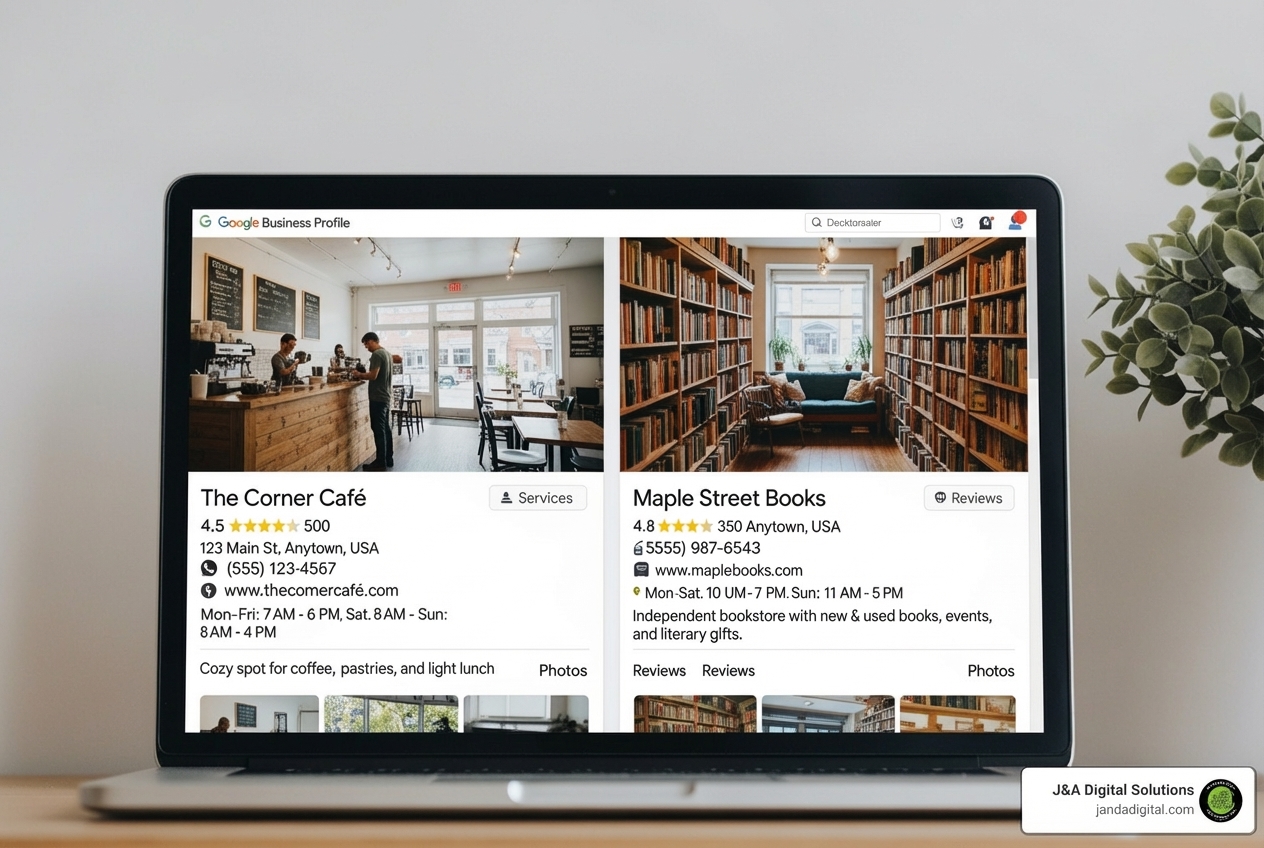
- Google Business Profile (GBP) Analysis: A competitor’s GBP is often more important than their website, as it’s a potential customer’s first point of contact. Dissect their GBP:
- GBP Categories: What primary and secondary categories are they using? This shows how Google classifies them and which services they emphasize. You might find categories you’ve overlooked.
- GBP Posts & Q&A: How often do they post updates? What questions are customers asking, and how do competitors respond? This reveals their engagement strategy.
- Photos & Videos: Quality and quantity matter. Businesses with photos on their profiles get 42% more direction requests and 35% more website clicks. Are your competitors using high-quality visuals to showcase their work?
- Local Citations (NAP): Your business name, address, and phone number (NAP) must be consistent across online directories (Yelp, Facebook, etc.). Inconsistent NAP data confuses search engines and hurts rankings.
- Citation accuracy is a key local search ranking factor. Check where your competitors are listed and ensure your own NAP information is consistent everywhere. Specialized online tools can help identify competitor citations.
- Local Link Building: Backlinks from relevant local sources (blogs, news sites) are valuable votes of confidence. Analyze your competitors’ backlink profiles using SEO tools. Are they getting links from local partners or news outlets in Columbus or Lancaster? This can reveal outreach opportunities.
- Website User Experience (UX): A competitor’s website reveals their professionalism.
- Mobile-Friendliness & Speed: Google uses mobile-first indexing, so a mobile-friendly site is non-negotiable. Run a Google PageSpeed Insights report on their site (and yours) to check speed and usability. Slow sites frustrate users and hurt rankings.
- On-Page SEO: Examine their website content for local keywords in titles, headings, and text. Do they use structured data (schema) to help search engines understand their services and location? Use tools like Google’s Structured Data Testing Tool to inspect their schema.
- Content Strategy: What content are competitors producing? Are they writing about local events, offering guides, or showcasing projects? This helps identify content gaps and opportunities to create hyperlocal content for your audience in Columbus or Lancaster.
Step 3: Decode Customer Sentiment and Online Reviews
Online reviews are an open book into a competitor’s strengths and weaknesses, revealing what their customers truly think.
- Review Platforms: Scour reviews on Google, Yelp, Facebook, and industry-specific sites relevant to your business in Columbus or Lancaster.
- Review Volume & Velocity: How many reviews do they have, and how recent are they? A high volume of recent, positive reviews suggests a thriving business with good customer satisfaction.
- Sentiment Analysis: Read the reviews, noting recurring themes. Are customers praising their staff and service, or are there frequent complaints about pricing, communication, or deadlines?
- Common Complaints: These are goldmines. If customers mention a competitor’s slow response time, that’s an opportunity for you to highlight your own promptness.
- Positive Feedback: What are customers raving about? This shows what works for them and what local customers value. Learn from their successes to improve your own service.
- Competitor Response Strategy: How do competitors respond to reviews, especially negative ones? Professional engagement reflects good customer service and reputation management.
Here are some key insights we’ll look for in reviews:
- Recurring praises: What do customers consistently love?
- Recurring complaints: What are the common pain points?
- Response patterns: How do they handle negative feedback? Do they offer solutions?
- Service mentions: What specific services or products are frequently highlighted (positively or negatively)?
- Actionable feedback: Often, reviews with 2-4 stars provide the most constructive criticism, pointing to areas for improvement.
- Summarization tools: For many reviews, AI tools can help summarize key themes.
By understanding customer feedback on your competitors, you can refine your own offerings to stand out.
Step 4: Gather In-Person Intel and Analyze Pricing
Online research is crucial, but a boots-on-the-ground perspective provides insights digital tools can’t. This step allows you to experience competitors as a customer would.
- Secret Shopping (or just “Smart Shopping”): If applicable, experience a competitor’s service directly. For instance, a cafe owner could visit a rival cafe to observe the atmosphere, service, and quality. This offers insights into their customer journey.
- In-Person Visits: Visiting competitor locations is illuminating. Observe their facilities, cleanliness, and staff demeanor. Note the general vibe and customer interactions. This is valuable for brick-and-mortar businesses in Columbus and Lancaster.
- Customer Service Quality: Note how customers are treated. Is the staff friendly and efficient? This can highlight areas where your customer service can excel.
- Pricing Strategies: This is a huge one. How do our competitors price their products or services?
- Do they offer bundles or packages?
- Is their pricing transparent, or do customers have to jump through hoops to get a quote?
- Are they positioned as a premium provider (higher price, perceived higher value) or a budget-friendly option?
- What exactly do customers get at each price point?
- Understanding their pricing models helps us position our own offerings competitively and identify opportunities for differentiation.
- Local Event Participation & Community Involvement: Are competitors visible at local events in Columbus or Lancaster? Do they sponsor local teams? Community involvement builds brand loyalty. If they’re not doing it, it’s an opportunity for you.
- Industry Networking: Attending local industry events or joining the Chamber of Commerce allows you to network. This can provide anecdotal insights into the local market.
From Analysis to Action: Gaining a Competitive Edge
Collecting data is just the beginning. The goal is to synthesize your findings into actionable strategies for a competitive edge.
Synthesizing Your Findings with a SWOT Analysis
A SWOT analysis is a powerful framework for summarizing all our competitor research and applying it directly to our own business. SWOT stands for Strengths, Weaknesses, Opportunities, and Threats.
Here’s how to perform a SWOT for your local competitor analysis:
- Strengths: What are your internal advantages? What do you do exceptionally well? This could be a unique service, excellent customer support, a strong local reputation, or team expertise.
- Weaknesses: What are your internal disadvantages? Where do you need to improve? This might be areas where competitors outperform you or inefficient internal processes. Honesty is key.
- Opportunities: What external factors can you leverage? This is where your analysis shines. Look for market gaps, underserved neighborhoods in Columbus or Lancaster, emerging trends, or customer pain points your competitors are failing to solve.
- Threats: What external factors could harm your business? This includes new competitors, a rival launching a new service, local economic shifts, or changing customer preferences.
By filling out a SWOT analysis template based on your research, you get a clear overview of your strategic position. This helps you capitalize on strengths, mitigate weaknesses, and prepare for threats.
Identifying Market Gaps and Adapting Strategies
The goal of local competitor analysis is to identify concrete actions.
- Service Gaps: Are there services your competitors aren’t offering, or offering poorly? A niche service in Columbus or Lancaster might be overlooked. This is your chance to introduce a unique offering.
- Underserved Neighborhoods: Your analysis might show competitors are strong in one area but weak in another. This is an opportunity to focus your local SEO and outreach efforts there.
- Improving on Competitor Weaknesses: You’ve identified their weaknesses from reviews, like a slow website or poor service. This is your roadmap. Actively promote your strengths in those areas. For example, if a competitor is slow to respond, highlight your own rapid service.
- Reverse-Engineering Success: Instead of copying competitors, understand why their strategies work. If their blog drives traffic, don’t just write similar posts. Analyze and improve upon their content with more detail, videos, or expert interviews to create a more valuable experience.
- Hyperlocal Content: Leverage your insights to create hyperlocal content for Columbus, OH, and Lancaster, OH. This could include neighborhood guides, local event spotlights, or how-to videos addressing local issues, establishing you as a trusted resource.
- Building Local Partnerships: Collaborate with non-competing local businesses. A plumbing company could partner with a local hardware store for joint promotions. A web design agency could team up with a local photography studio. These partnerships can expand our reach, increase our credibility, and generate valuable local backlinks.
- Ongoing Monitoring: The local market is dynamic. Local competitor analysis is not a one-time task. Set a regular cadence—monthly or quarterly—to monitor competitors. This continuous vigilance ensures you maintain your competitive edge.
Frequently Asked Questions about Local Competitor Analysis
What’s the difference between market analysis and competitor analysis?
A market analysis gives a broad overview of an industry, including its size, trends, and demographics. It’s like surveying the entire forest.
A competitor analysis, however, focuses on specific rivals, digging into their strategies, strengths, and weaknesses. This is like studying the individual trees nearby. Both are essential for strategic planning.
How often should I perform a local competitor analysis?
The frequency of your local competitor analysis depends on your industry’s pace. For most small businesses in Columbus and Lancaster, we recommend monthly or quarterly monitoring.
- Monthly: Ideal for competitive markets or when implementing new strategies. Focus on quick checks like GBP updates, new reviews, and social media.
- Quarterly: A more in-depth review every three months helps track larger trends in SEO, content, and market positioning, allowing for strategic adjustments.
Local SEO is ongoing. Consistent monitoring ensures you aren’t caught off guard by new competitors or shifting tactics.
What are the most important things to look at in a competitor’s Google Business Profile?
When analyzing a competitor’s Google Business Profile, focus on critical elements that impact their local visibility and customer perception:
- Primary and Secondary Categories: These show how Google classifies their business and what services they want to rank for. Are they using categories you’re missing?
- Photos and Videos: High-quality visuals boost engagement. Look at the quantity, quality, and types of their photos and videos (e.g., storefront, team, work examples).
- Reviews (Volume, Sentiment, Responses): This is arguably the most important element. Analyze:
- Volume: How many reviews do they have? More reviews often mean more trust.
- Average Rating: Their overall star rating.
- Sentiment: What are the recurring themes in positive and negative reviews? This provides direct customer feedback.
- Responses: Do they respond to all reviews, especially negative ones? This demonstrates customer care and reputation management.
- GBP Posts: Are they regularly sharing updates, offers, or news? This indicates an active presence and can reveal their current promotions.
- Q&A Section: What questions are customers asking, and how are they answered? This can highlight common customer concerns.
- Services/Products Listed: Many GBPs allow businesses to list specific services, providing a direct look at their offerings.
By scrutinizing these GBP elements, you gain a comprehensive understanding of their local search strategy and customer interactions in Columbus and Lancaster.
Conclusion: Dominate Your Local Market
With over 33 million small businesses, simply existing isn’t enough. To thrive in Columbus, OH, and Lancaster, OH, you must understand your local ecosystem. Local competitor analysis isn’t a fancy term; it’s your roadmap to sustained growth and market dominance.
This guide walked you through identifying rivals, analyzing their digital footprint and reviews, and gathering in-person intelligence. You learned to synthesize these findings with a SWOT analysis to pinpoint market gaps and adapt your strategies for maximum impact.
The journey from analysis to action is where you transform insights into results. By continuously monitoring and adapting based on what you learn, you can ensure your business stays one step ahead.
At J&A Digital Solutions, we specialize in helping local businesses like yours not just compete, but truly dominate “near me” searches. Our proprietary lead generation system is designed to leverage these insights, ensuring you get real customers without risk, backed by our “5 Lead Guarantee.”
Ready to stop guessing and start dominating your local search results? Let’s turn those competitive insights into your next big success story. Start dominating your local search results.