

From Local to Legend: Unlocking Your Business’s Growth Potential
Why Most Local Businesses Stay Small — And How to Change That
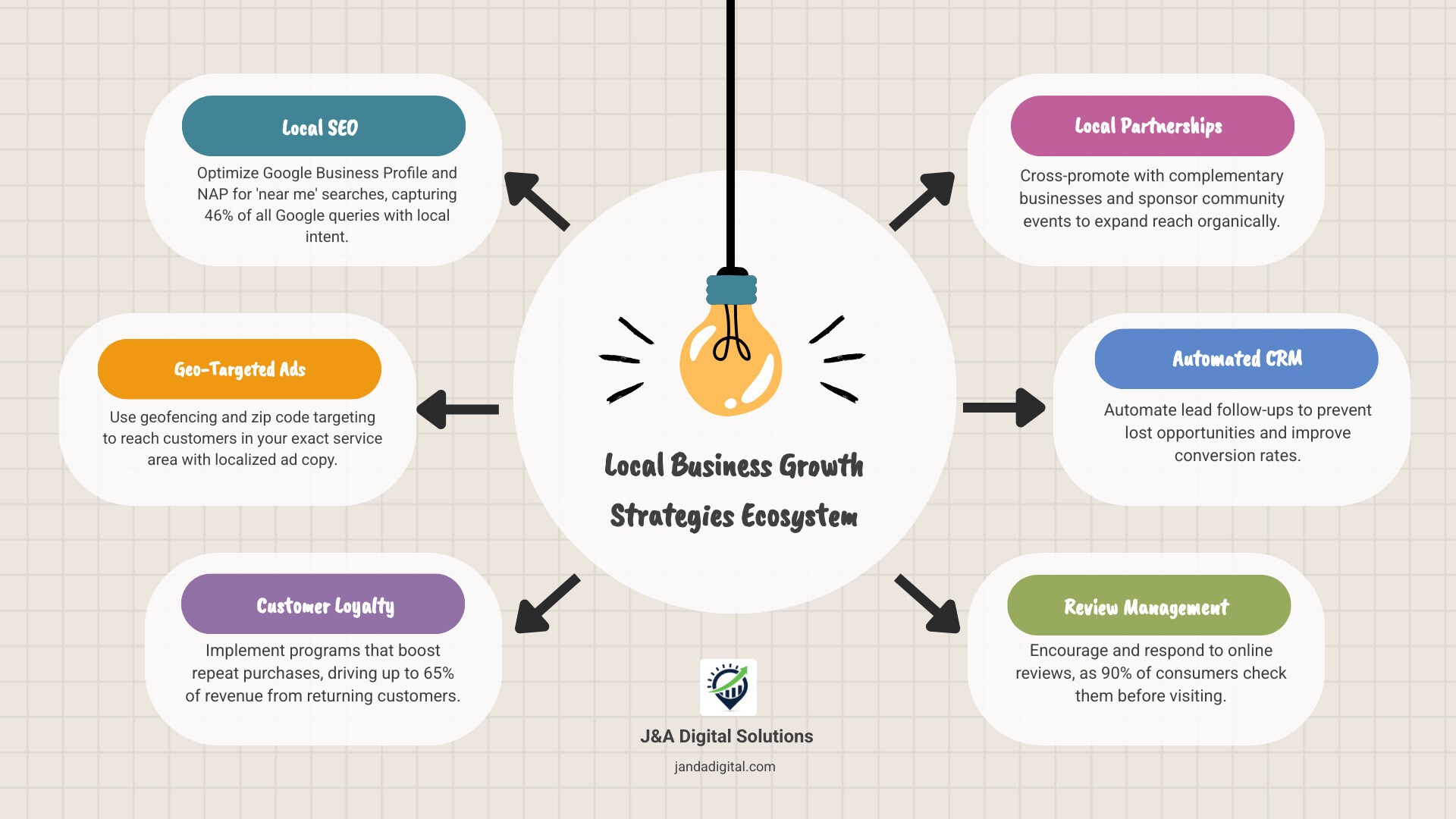
Local business growth strategies are the specific actions you take to attract more nearby customers, keep the ones you have, and scale your revenue over time. Here’s a quick overview of the most effective approaches:
- Optimize your Google Business Profile — show up when people search “near me”
- Run geo-targeted ads — reach customers within your exact service area
- Build a customer loyalty program — returning customers drive up to 65% of revenue
- Form local partnerships — cross-promotions with complementary businesses grow your reach fast
- Automate your follow-up — CRM tools stop leads from slipping through the cracks
- Create hyperlocal content — blog posts and social media tied to your community build trust and search rankings
- Manage your online reviews — over 90% of consumers read reviews before visiting a business
Running a local business in 2026 is harder than it looks from the outside. You’re competing with national chains, online giants, and a dozen other local operators — all fighting for the same customers in the same zip codes. And here’s the uncomfortable truth: staying flat isn’t staying safe. Small businesses need a year-over-year growth rate of at least 15% just to stay ahead of inflation and have enough left over to reinvest. Standing still is actually moving backward.
The good news? Local businesses have a real advantage that no big-box chain can replicate: genuine community connection. When 46% of all Google searches have local intent, and 76% of people who search for something nearby visit a business within 24 hours, the opportunity is right in front of you. You just need the right strategies to capture it.
I’m Josh Preece, founder of J&A Digital Solutions and a digital marketing specialist with over 20 years of experience helping local service businesses implement local business growth strategies that generate consistent, measurable leads. In the guide below, I’ll walk you through exactly what works — from dominating local search to building the kind of customer loyalty that compounds over time.
Related content about local business growth strategies:
The Foundation of Sustainable Local Business Growth Strategies
Before you spend a dime on ads or start a TikTok dance challenge to promote your plumbing service, you need a solid foundation. Think of it like building a house in Columbus or Lancaster—you wouldn’t start framing the walls without a blueprint. Sustainable growth requires a deep understanding of who you are serving and why they should choose you over the guy down the street.
To start, you need to define your Unique Selling Proposition (USP). This is the “secret sauce” that makes your business the obvious choice. Are you the only 24-hour emergency HVAC tech in Fairfield County? Do you offer a “5 Lead Guarantee” like we do? Once you know your USP, you can build your buyer personas—detailed profiles of your ideal customers, including their pain points, demographics, and where they hang out online.
Setting SMART goals (Specific, Measurable, Achievable, Relevant, and Time-bound) is equally critical. Instead of saying “I want to grow,” say “I want to increase our local service calls in the 43215 zip code by 20% by December 2026.” This level of clarity allows you to measure success and pivot when things aren’t working. For those looking to dive deeper into how to position their brand, check out our local marketing services for a comprehensive look at neighborhood-level dominance.
Defining Your Local Market Landscape
The local landscape in Ohio is constantly shifting. To win, we have to look beyond just “the competition.” You need to analyze the specific neighborhood trends in areas like German Village or the historic districts of Lancaster.
- Demographics: Is the neighborhood getting younger? Are there more first-time homebuyers who might need home services?
- Competitor Analysis: What are your competitors’ strengths? If they have 500 five-star reviews, you can’t just ignore them—you need a strategy to close that gap.
- Consumer Behavior: In 2026, convenience is king. If your competitors offer online booking and you require a three-minute phone call just to get a quote, you’re losing the “behavior” battle.
Short-Term vs. Long-Term Planning
Growth is a multi-tiered game. You need short-term wins to keep the lights on and long-term strategies to build an empire.
- Short-Term: These are your “checklists” for daily actions. Responding to Google reviews, posting a photo of a completed job to social media, or running a quick weekend promo.
- Long-Term: This involves scalability and resource allocation. Are you planning to add a second van to your fleet next year? How will your CRM handle a 300% increase in leads?
Balancing these two ensures you don’t burn out while chasing a distant goal. For more on how to simplify this process, our guide on Mastering Digital Marketing Simple Strategies for Success is a great starting point for owners who feel overwhelmed.
Dominating the Digital Map: Local SEO and Hyperlocal Tactics
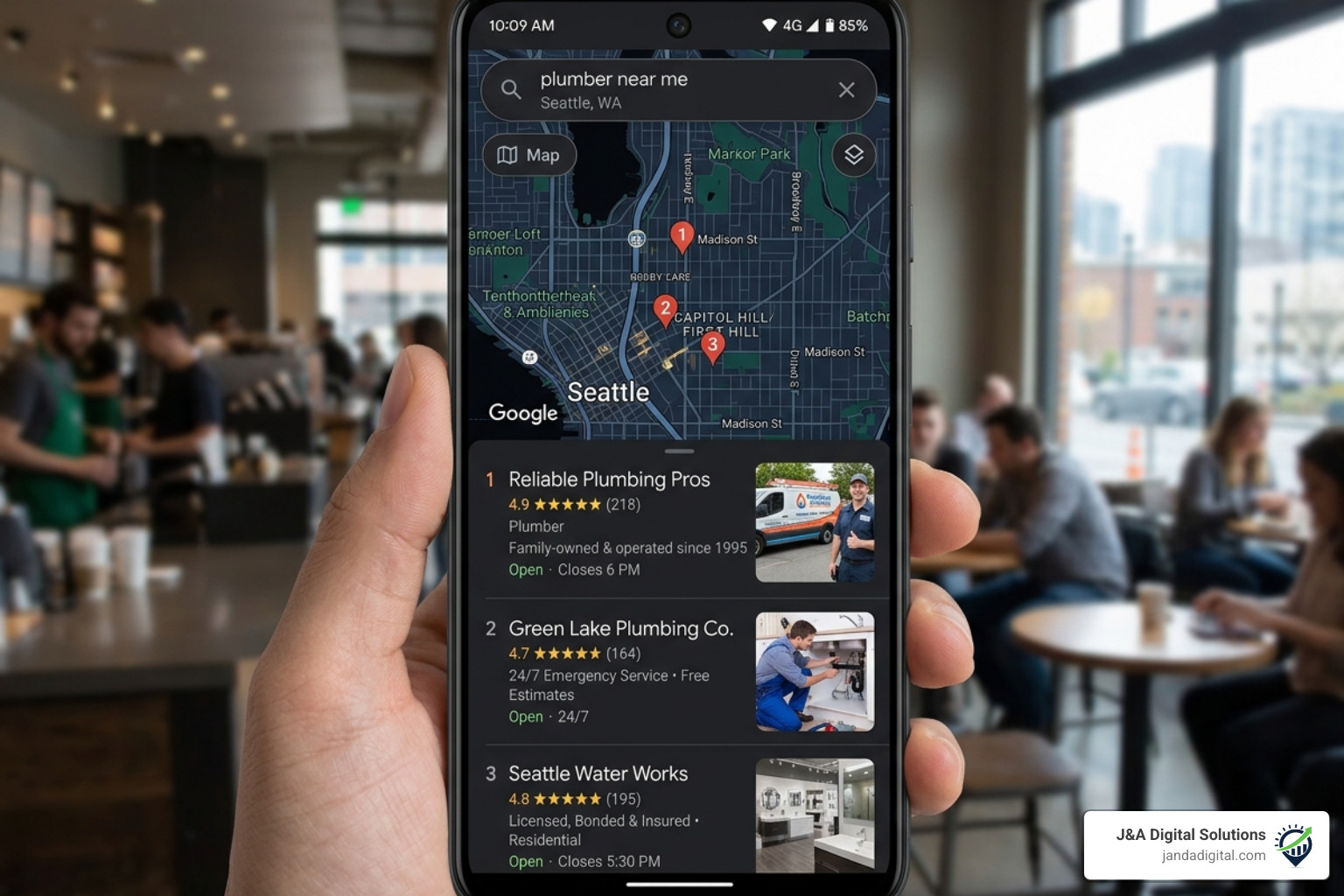
If you aren’t visible on the “Local Pack”—those top three results on Google Maps—you’re essentially invisible to 46% of searchers. In today’s market, “near me” intent is the highest form of buying signal. When someone in Columbus searches for “emergency plumber near me,” they aren’t browsing; they have a problem that needs solving now.
The cornerstone of this visibility is NAP consistency (Name, Address, Phone number). If your business is listed as “J&A Digital” on Google but “J and A Solutions” on Yelp, search engines get confused. Confusion leads to lower rankings. Furthermore, with mobile-first indexing, your website must load instantly and look perfect on a smartphone. Most local searches happen on the go, and a slow site is the fastest way to send a customer to your competitor. Our deep dive into Local SEO covers these technical aspects in detail to ensure your digital storefront is always open.
Optimizing Your Google Business Profile for Local Business Growth Strategies
Your Google Business Profile (GBP) is often the first interaction a customer has with your brand. It’s your virtual storefront. To make it a lead-generating machine, you must:
- Manage Reviews Actively: Don’t just collect them; respond to them. Even the bad ones. It shows you’re a real human who cares about service.
- Use Google Posts: Treat this like a mini-blog. Share updates, seasonal offers, or “behind the scenes” photos of your team at work in Lancaster or Columbus.
- Upload High-Quality Media: Profiles with photos get 35% more clicks. Show off your clean trucks, your friendly staff, and your finished projects.
- Leverage the Q&A Section: Don’t wait for customers to ask questions. Post your own frequently asked questions and answer them yourself.
For a step-by-step roadmap, see our 10 Proven Strategies to Boost Your Local Google Rating.
Hyperlocal Advertising and Geo-Targeted Campaigns
Sometimes organic SEO takes time, and you need leads today. This is where hyperlocal advertising comes in. Instead of blasting an ad to all of Ohio, we use zip code targeting and geofencing.
Imagine running a Facebook ad that only shows up for people within a three-mile radius of your shop in Columbus. Or using geofencing to trigger a mobile ad when a potential customer enters a virtual boundary around a local home improvement show. By using localized ad copy—mentioning specific local landmarks or community events—you increase the relevance and conversion rate of every dollar spent.
Retention and Expansion: Beyond Customer Acquisition
It costs five times as much to acquire a new customer as it does to keep an existing one. Yet, many businesses obsess over new leads while ignoring the goldmine they already have.
| Feature | Horizontal Growth | Vertical Growth |
|---|---|---|
| Focus | New markets/customers | Existing customers |
| Goal | Increase reach | Increase Customer Lifetime Value (LTV) |
| Tactic | Market expansion/Ads | Upselling/Loyalty programs |
| Cost | High (Acquisition) | Low (Retention) |
To grow vertically, you need to focus on Customer Lifetime Value (LTV). Encourage User-Generated Content (UGC) by asking customers to tag your business in their social media posts. This creates authentic social proof that no paid ad can match. If you’re a service provider in Georgia or Ohio, understanding these nuances is key, as explained in our SEO for Small Business GA guide.
Implementing Loyalty Programs as Local Business Growth Strategies
Did you know that customer loyalty programs can increase purchases by as much as 300%? In 2026, these aren’t just punch cards. They are integrated into your CRM (Customer Relationship Management) system.
- Personalized Offers: Send a discount code on their “customer anniversary.”
- Subscription Models: Can you turn a one-time service into a recurring monthly maintenance plan?
- Automated Rewards: Use your tech stack to track points and notify customers when they’ve earned a reward.
This keeps your brand top-of-mind. As we often discuss, Why SEO is Important in a Small Town often comes down to that repeat trust and word-of-mouth that starts with a great loyalty experience.
Strategic Partnerships and Community Involvement
You don’t have to grow alone. Strategic partnerships with complementary businesses can double your reach overnight. If you’re a landscaper, partner with a local nursery. You can offer cross-promotions: “Get 10% off your first mulch delivery with a receipt from the nursery.”
Community involvement is also a powerful growth lever. Sponsoring a Little League team in Lancaster or hosting a workshop at a Columbus library transforms your business from a “vendor” to a “neighbor.” Joining the local Chamber of Commerce or networking groups helps you build a referral flywheel that operates even when you aren’t actively marketing.
Overcoming Operational Hurdles with Technology
Many local business owners hit a ceiling because of “tech overwhelm” or limited resources. You feel like you’re wearing twenty hats, and “marketing” is the one that keeps falling off. In 2026, technology isn’t just for big corporations—it’s the great equalizer for small businesses.
Common challenges like funding constraints and talent acquisition can be mitigated by using the right tools. Instead of hiring a full-time receptionist, an automated booking system can handle appointments 24/7. Instead of wondering why your ads aren’t working, AI-driven analytics can tell you exactly which zip codes are converting. To see how the pros do it, check out Local SEO Secrets for insights into the tech stacks used by top-tier agencies.
Leveraging AI and Automation for Efficiency
Automation is the key to scaling without losing your mind.
- Agentic AI: This isn’t just a chatbot; it’s an AI that can actually solve problems, schedule appointments, and follow up with leads based on their specific needs.
- Lead Management: Use a CRM to centralize every inquiry from your website, Facebook, and Google. No more “lost” sticky notes.
- Smart EPOS: Modern Electronic Point of Sale systems do more than take payments. They track inventory, monitor peak hours, and even suggest which products are lagging.
Measuring Success with Key Metrics
You can’t manage what you don’t measure. To know if your local business growth strategies are working, you must track:
- Conversion Rates: Of the people who visit your site, how many actually call or book?
- Customer Acquisition Cost (CAC): How much do you spend on marketing to get one new customer?
- Repeat Purchase Frequency: How often do your “loyalty” customers come back?
- ROI Tracking: For every $1 spent on local SEO or ads, how much revenue is generated?
Frequently Asked Questions about Local Growth
How do I measure the success of my local growth plan?
Success is measured through a combination of KPI tracking and real-world results. Use GMB Insights to see how many people are requesting directions or calling you directly from Google. Monitor your year-over-year revenue growth (aiming for that 15% mark) and track physical foot traffic or service call volume.
What is the most cost-effective way to attract local customers?
Optimizing your Google Business Profile is the highest ROI activity because it’s free to set up and puts you in front of high-intent searchers. Beyond that, word-of-mouth and community networking are low-cost ways to build a reputation. Organic social media, when focused on local stories rather than “selling,” is also highly effective.
How can technology like AI help a small local business?
AI can handle customer support through smart messaging, manage inventory by predicting busy seasons, and provide data analysis that shows you exactly where your leads are coming from. It allows a small team to perform like a much larger company by automating repetitive tasks.
Conclusion
Unlocking your business’s growth potential in 2026 requires a blend of old-school community values and new-school digital precision. By focusing on a resilient ecosystem of local SEO, customer retention, and smart technology, you can move from being “just another shop” to a local legend.
At J&A Digital Solutions, we specialize in making this transition seamless. We don’t just “do marketing”—we provide a proprietary lead generation system that ensures you dominate “near me” searches. We are so confident in our ability to deliver that we offer a 5 Lead Guarantee, providing you with real, hot local leads without the risk. Whether you need SEO in Columbus Ohio or a complete digital overhaul, we are here to help you scale.
Ready to stop chasing leads and start closing them? Contact us to start growing your local business today and let’s put your growth on autopilot.