

Is Cyber Monday Better Than Black Friday 2026: Ultimate Guide
The Ultimate Showdown: Black Friday vs. Cyber Monday
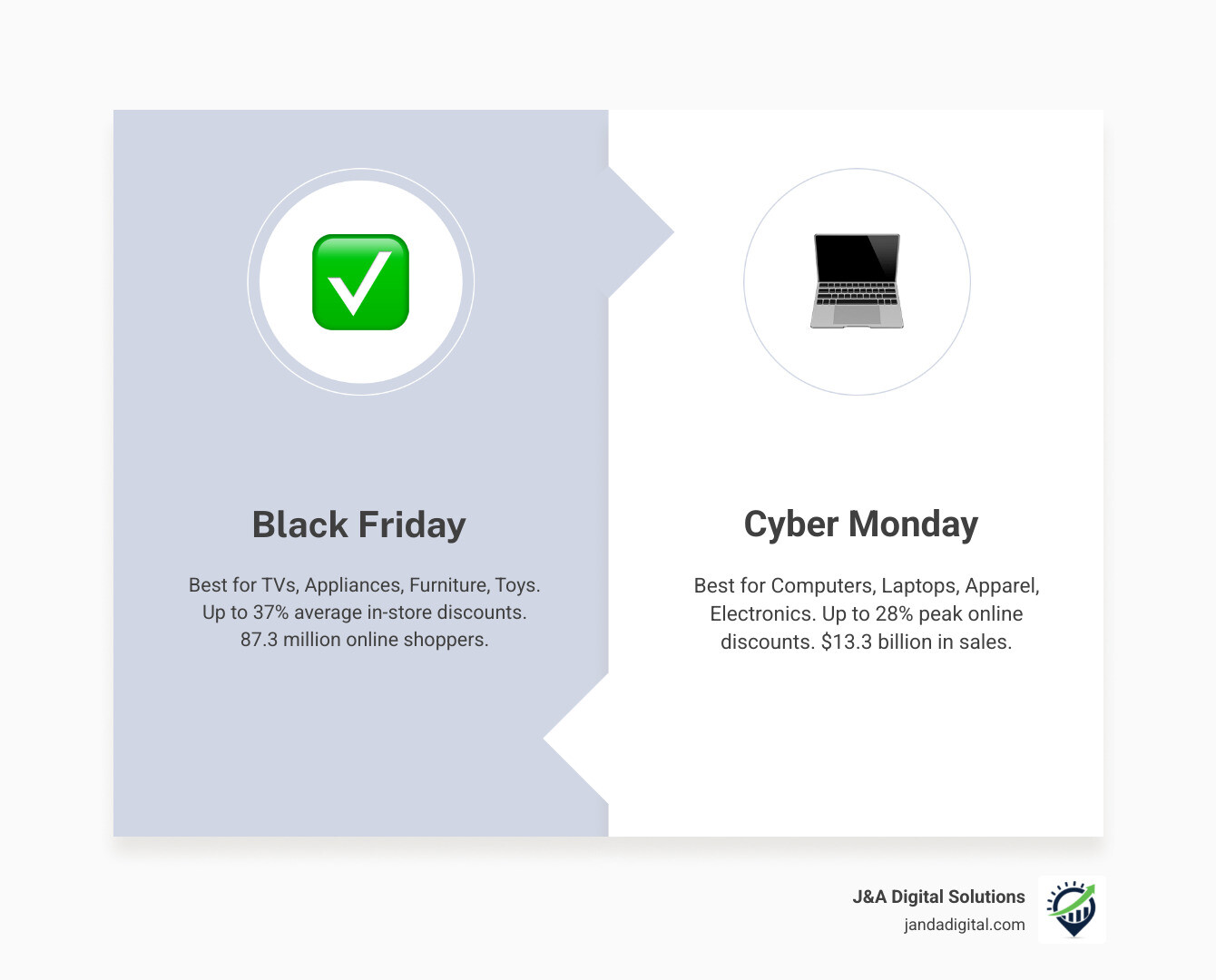
Is Cyber Monday better than Black Friday? The answer depends on what you’re shopping for and how you prefer to shop. Here’s the quick breakdown:
| Shopping Day | Best For | Average Discounts | Shopping Style |
|---|---|---|---|
| Black Friday | TVs, appliances, furniture, toys | 23-37% off | In-store doorbusters + online |
| Cyber Monday | Computers, laptops, apparel, electronics | 23-28% off | Online-only deals |
The five-day shopping period from Thanksgiving through Cyber Monday is where the magic happens. For example, in a recent year, shoppers spent $13.3 billion on Cyber Monday alone, while 87.3 million people shopped online on Black Friday. But here’s the truth: the lines between these two shopping holidays have blurred significantly.
Black Friday traditionally meant camping outside stores for doorbuster deals on big-ticket items. Cyber Monday emerged in 2005 as the online shopping alternative, coined by the National Retail Federation to capture the surge in online purchases when people returned to work after Thanksgiving.
Today, both days offer incredible savings, but they shine in different categories. Black Friday still dominates for large electronics and appliances with average in-store discounts hitting 37%. Cyber Monday takes the lead for tech accessories, fashion, and online-exclusive products, with discounts peaking at 28% by the end of the shopping weekend.
The real question isn’t which day is universally “better”—it’s which day is better for what you need. Major retailers now extend sales across the entire “Cyber Week,” making it less about a single day and more about strategic timing for specific purchases.
As Josh Preece, founder of J&A Digital Solutions with over 20 years of digital marketing experience, I’ve helped countless businesses steer the complexities of is cyber monday better than black friday shopping trends to optimize their own promotional strategies. Understanding these consumer behavior patterns is crucial whether you’re a shopper hunting deals or a business owner planning your marketing calendar.
Know your is cyber monday better than black friday terms:
- Black Friday Cyber Monday: The Ultimate Explainer
- Cyber Monday Marketing Strategies
- Essential Omnichannel Strategies for Cyber Monday
From In-Store Frenzy to Online Bonanza: The Evolution of Holiday Shopping
The holiday shopping season has a rich, albeit somewhat chaotic, history. It all began with Black Friday, a term first used by Philadelphia police in the 1950s to describe the massive crowds and traffic jams that would descend upon the city the day after Thanksgiving. It was a day of in-store frenzy, characterized by shoppers literally busting down doors to grab limited-stock “doorbuster” deals. Retailers later cleverly reframed the term in the late 1980s to signify profitability, moving from being “in the red” to “in the black” financially. Black Friday became synonymous with the official start of the Christmas shopping season, primarily focused on brick-and-mortar stores and enticing discounts on big-ticket items.
Fast forward to 2005, and a new player entered the arena: Cyber Monday. The National Retail Federation coined the term “Cyber Monday” in 2005 after observing a significant uptick in online shopping on the Monday following Thanksgiving. This phenomenon was largely attributed to people returning to work after the holiday weekend, where they had access to faster internet connections than at home (a quaint thought now, isn’t it?). E-commerce sellers, feeling a bit left out of the guaranteed revenue boost brick-and-mortar stores enjoyed on Black Friday, saw this as an opportunity to capitalize on the Thanksgiving weekend sales. Thus, Cyber Monday was born as the online counterpart, promising digital discounts for shoppers from the comfort of their office chairs – or, increasingly, their homes.
Over the years, both Black Friday and Cyber Monday have evolved dramatically. The rise of e-commerce and the increasing comfort consumers have with online shopping have blurred the lines between these two once-distinct events. What started as two separate days has largely merged into a single, extended “Cyber Week” shopping period. The COVID-19 pandemic further accelerated this shift, forcing many traditional brick-and-mortar stores to pivot heavily to online sales, effectively erasing much of the historical distinction. Today, the choice between Black Friday and Cyber Monday is less about where you shop (online vs. in-store) and more about what you buy and when you find the best deal.
When Do the Sales Actually Start?
Gone are the days when holiday sales were confined to just Black Friday and Cyber Monday. The shopping season now kicks off much earlier, often starting in early November, or even as early as Halloween! Many retailers launch “early Black Friday” deals weeks before Thanksgiving, turning the entire month into “Black November.”
Thanksgiving Day itself has become a significant online shopping day, with many retailers offering deals even while most physical stores remain closed. Black Friday deals, while officially on the Friday after Thanksgiving (November 27, 2026), often begin online on the Wednesday or even Tuesday before, and typically run through the entire weekend.
Cyber Monday (November 30, 2026) deals, too, have expanded beyond a single day. Many “Cyber Monday” promotions unofficially begin on the Saturday after Black Friday (November 28, 2026) and extend through Monday, sometimes even into “Cyber Tuesday.” For instance, major retailers like Amazon often start their Cyber Monday events on the Saturday after Black Friday. As an example from a past year, Amazon’s 2025 Cyber Monday shopping event started on Saturday, November 29, and ran through December 1. This extended promotional period means savvy shoppers in Columbus Ohio and Lancaster Ohio have a much wider window to snag deals, but also requires more strategic planning to ensure they don’t miss out on specific items.
A Head-to-Head Deal Comparison: What to Buy and When
When it comes to finding the best deals, the age-old question of is cyber monday better than black friday often boils down to the specific products you’re targeting. While the overall shopping period has become a blended “Cyber Week,” retailers still strategically concentrate their deepest discounts on certain categories for one day or the other. Understanding these patterns is key to maximizing your savings.

Retailer strategies play a significant role here. They use Black Friday and Cyber Monday to clear inventory, hit end-of-year financial targets, and generate buzz. For businesses in Columbus Ohio and Lancaster Ohio, understanding these consumer deal-hunting behaviors is paramount for effective marketing strategies. Just as we help businesses craft Effective Content Marketing Strategies for SEO and SEM Growth, consumers can employ similar strategic thinking to their shopping.
Here’s a breakdown of what typically sees better discounts on each day:
| Product Category | Typically Better on Black Friday | Typically Better on Cyber Monday | Average Discount Range |
|---|---|---|---|
| Televisions | Yes (often larger models) | Occasionally, but less significant | 23-27% (BF) |
| Large Appliances | Yes (refrigerators, washers, dryers) | No | 23-27% (BF) |
| Furniture | Yes | No | 23-27% (BF) |
| Toys | Yes (early in the season) | Yes (often for games & smaller items) | 23-27% (BF), 26% (CM) |
| Computers/Laptops | Sometimes (select models) | Yes (deeper discounts) | 23-28% (CM) |
| Apparel/Shoes | Sometimes | Yes (often higher percentages) | 23-28% (CM), up to 60% |
| Small Electronics | Sometimes | Yes (headphones, smart home devices) | 23-28% (CM) |
| Digital Services | No | Yes (subscriptions, software) | Varies (e.g., 50% off) |
| Travel Deals | No | Yes (often on Travel Tuesday) | Varies |
Black Friday’s Best Buys: Big-Ticket Items and In-Store Finds
If you’re on the hunt for substantial purchases, Black Friday traditionally delivers. We’re talking about those items that make a real statement in your home or under the tree. Deals on TVs, toys, and furniture will top out on Black Friday, with discounts ranging from 23% to 27% off.
- Televisions: Black Friday remains the king for big-screen TVs. Retailers often use these as loss leaders to get shoppers into stores (or onto their websites). If you’re eyeing a new 4K smart TV, this is usually your prime opportunity.
- Large Appliances: Need a new refrigerator, washing machine, or oven? Black Friday typically brings the deepest discounts on major home appliances. This is a great time to upgrade if you’ve been waiting.
- Furniture: Whether it’s a new sofa, dining set, or mattress, furniture often sees significant price drops during Black Friday sales.
- Toys: While toys appear on both days, Black Friday often features strong early-season deals, especially for popular items that might sell out closer to Christmas.
Historically, Black Friday was also about in-store exclusives and the thrill of the chase. While many of these deals are now available online, the average in-store discount on goods on Black Friday can still be a significant 37%, compared to around 20% in the week beforehand. So, if you enjoy the experience of physically shopping, Black Friday might still hold some unique in-store gems.
Cyber Monday’s Sweet Spots: Tech, Fashion, and Online Exclusives
Cyber Monday, as its name suggests, is where online-centric deals truly shine. While Black Friday might snag the big-ticket items, Cyber Monday often offers deeper cuts on personal tech, fashion, and anything you can buy digitally. Sales on computers, apparel and other electronics are expected to reach an apex on Cyber Monday, with discounts ranging from 23% to 28% off.
- Computers and Laptops: If you’re in the market for a new laptop, desktop, or tablet, Cyber Monday often brings more aggressive discounts than Black Friday. This is especially true for specific models and configurations.
- Apparel and Shoes: Fashionistas, rejoice! Cyber Monday is generally the better day for clothing and footwear. We’ve seen discounts as high as 60% off from some retailers on Cyber Monday, making it an ideal time to refresh your wardrobe or grab gifts for loved ones.
- Small Electronics and Accessories: Think headphones, smartwatches, smart home devices, gaming accessories, and charging gear. These items tend to see their steepest price drops on Cyber Monday.
- Digital Services and Software: Online subscriptions, software licenses, streaming services, and online courses frequently offer their best deals on Cyber Monday. For instance, services like MasterClass or Rosetta Stone might offer 50-60% off their annual memberships.
- Travel Deals: While not strictly Cyber Monday, “Travel Tuesday” (the day after Cyber Monday) has emerged as a dedicated day for discounts on flights, hotels, and vacation packages. If you’re planning a getaway, keep an eye out then!
So, Is Cyber Monday Better Than Black Friday for Deals?
The question is cyber monday better than black friday isn’t as simple as it once was. The retail landscape has shifted dramatically, turning these two distinct days into a more fluid, extended shopping period. However, looking at overall spending trends and average discount percentages, we can draw some conclusions.
Cyber Monday consistently leads in online spending, setting new records each year. In a recent year, for example, shoppers poured a staggering $13.3 billion into online purchases on Cyber Monday, marking a significant increase from the previous year. This makes it historically the most profitable day for e-commerce sales every year. Black Friday, while still a behemoth, sees a slightly lower online spending total, though it remains the most popular day for overall shopping when factoring in both online and in-store purchases (with recent data showing 87.3 million online shoppers compared to Cyber Monday’s 64.4 million).
When it comes to the depth of discounts, the picture is nuanced. Discounts rise to about 21% on average pre-Thanksgiving before peaking at 28% by Cyber Monday. This suggests that, on average, the deals might be slightly better as the “Cyber Week” progresses. However, this is heavily influenced by product category, as we’ve discussed.
Factors like supply chain issues and economic conditions also play a crucial role. Retailers strategically use these sales events to manage inventory, clear financial projections, and respond to consumer demand. In a challenging economic climate, they might offer deeper discounts to entice wary shoppers. For businesses in Columbus Ohio and Lancaster Ohio, understanding these dynamics is critical for developing effective promotional campaigns. This is precisely why we emphasize the importance of strategies like those outlined in 7 Successful Cyber Monday Marketing Strategies You Need to Use—to help businesses not just participate, but truly thrive during these peak seasons.
The Data-Driven Answer to: Is Cyber Monday Better Than Black Friday?
Based on the data, the answer to is cyber monday better than black friday is a resounding “it depends on what you’re buying.” However, for overall online revenue and average discount depth across a broad range of categories, Cyber Monday often edges out Black Friday.
- Online Sales Volume: Cyber Monday consistently reigns supreme in online sales volume. In 2019, it broke online sales records with a total of $9.4 billion in sales, an increase of 19% from 2018. More recently, that figure climbed to an impressive $13.3 billion. This consistent performance solidifies its position as Cyber Monday is historically the most profitable day for e-commerce sales every year.
- Discount Depth: While Black Friday boasts a higher average in-store discount (37%), Cyber Monday’s overall average discount across all categories tends to be slightly higher, peaking at 28% by the end of the weekend. This is particularly true for electronics (excluding TVs), apparel, and digital services.
- Product Specificity: As highlighted earlier, Black Friday often offers better deals on big-ticket items like TVs, large appliances, and furniture. Cyber Monday, however, usually has superior discounts on computers, laptops, apparel, and smaller electronics.
So, while Black Friday might still be the single most popular day for overall shopping, Cyber Monday often provides the more substantial savings for online-focused purchases and a wider range of product categories.
Why the Lines Have Blurred: The Rise of “Cyber Week”
The clear distinction between Black Friday and Cyber Monday has become a relic of the past. Several factors have contributed to this blurring, leading to the rise of what we now affectionately call “Cyber Week.”
- The Pandemic’s Influence: The COVID-19 pandemic acted as a massive accelerator for online shopping. With physical stores facing restrictions, retailers were forced to push their Black Friday deals online, effectively merging the two events out of necessity. This habit has largely stuck, making online shopping becoming the year-round favored method for many consumers.
- Retailer Competition: The intense competition among retailers means no one wants to miss out on sales. If one retailer starts early, others follow suit. This race to the bottom (in terms of pricing) has led to sales beginning weeks before Thanksgiving and extending well past Cyber Monday.
- Consumer Convenience: Shoppers simply prefer the convenience of browsing and buying from their couches. The idea of battling crowds for a deal now seems less appealing than it once did.
- Inventory Management: Extended sales periods allow retailers to better manage their inventory, preventing both stockouts and excess merchandise.
The verdict on is cyber monday better than black friday is that they are now often two phases of a single, extended holiday shopping blitz. Instead of asking which day is better, we should ask which part of the Cyber Week offers the best deals for our specific needs. This shift demands a more strategic approach from both shoppers and businesses alike.
Your Pro Shopper’s Playbook for Maximum Savings
Navigating the labyrinth of Black Friday and Cyber Monday deals can feel like a sport. But with a solid strategy, you can emerge victorious, scoring incredible savings without the stress. This is where your inner digital marketing strategist, much like ours at J&A Digital Solutions, comes in handy. Just as we use targeted campaigns to generate local leads in Columbus Ohio and Lancaster Ohio, you can use a targeted approach to your shopping.

Our approach to Mastering Digital Marketing: Simple Strategies for Success emphasizes planning and research, and the same applies to your holiday shopping. Here are our essential tips:
- Make a list and set a budget: This is your golden rule. Decide what you need and how much you’re willing to spend before the sales hit. This prevents impulse buys and helps you stay focused.
- Research prices in advance: Don’t trust every “sale” sticker. Use price tracking tools (like camelcamelcamel.com for Amazon) to see an item’s price history. This helps you identify genuine discounts versus inflated “sales.”
- Sign up for email newsletters: Many retailers offer exclusive early access to deals or special coupon codes to their subscribers. Sign up for your favorite stores’ newsletters a few weeks before Thanksgiving.
- Check return policies and shipping times: Especially for holiday gifts, ensure you understand the return window and any associated fees. Also, verify estimated shipping times to make sure your purchases arrive when you need them.
- Use price comparison tools: Browser extensions and apps can automatically compare prices across different retailers, ensuring you’re getting the best deal on the spot.
- Be flexible: While we’ve highlighted general trends, a great deal can pop up at any time during Cyber Week. If you see an item you want at a price you’re happy with, it’s often wise to grab it rather than waiting for a potentially non-existent “better” deal.
- Consider “Cyber Tuesday”: If you’re looking for travel deals, don’t forget the Tuesday after Cyber Monday, which has become known as “Travel Tuesday” for discounts on flights and accommodations.
Conclusion: The Final Verdict on Your Holiday Shopping
The debate over is cyber monday better than black friday has evolved from a simple comparison of two distinct days into a nuanced discussion about strategic shopping during an extended holiday sales period. The modern shopping landscape is characterized by blurred lines, early deals, and a strong online presence for both events, heavily influenced by the convenience demanded by consumers and the competitive strategies of retailers.
There’s no single “better” day. Instead, the best strategy is a smart strategy. By understanding the historical differences, the current trends, and which types of products are typically discounted more on each day, you can become a savvy shopper. Plan ahead, do your research, and be prepared to act when you find a deal that meets your needs.
For business owners in Columbus Ohio and Lancaster Ohio, understanding these consumer trends is not just about personal savings—it’s key to growth. The shift towards online shopping, the extension of sales periods, and the emphasis on product-specific deals all highlight the critical need for a robust digital marketing strategy. At J&A Digital Solutions, we specialize in helping small to medium-sized businesses steer this complex landscape, ensuring they can effectively reach customers searching for “near me” services during peak shopping times and throughout the year.
Whether you’re hunting for a new TV or a laptop, or if you’re a business owner looking to optimize your holiday sales strategy, the principles of smart planning and targeted execution remain the same. If you’re a local business ready to capitalize on these trends and generate guaranteed hot local leads, let us help you Develop your business’s marketing strategy and ensure your business is not just participating, but truly dominating your market.