

Resource page link building: Master 3 Steps
Why Resource Page Link Building Remains a Powerful Strategy in 2025
Resource page link building is a proven SEO strategy where you earn backlinks from curated lists of helpful resources on other websites. Here’s how it works:
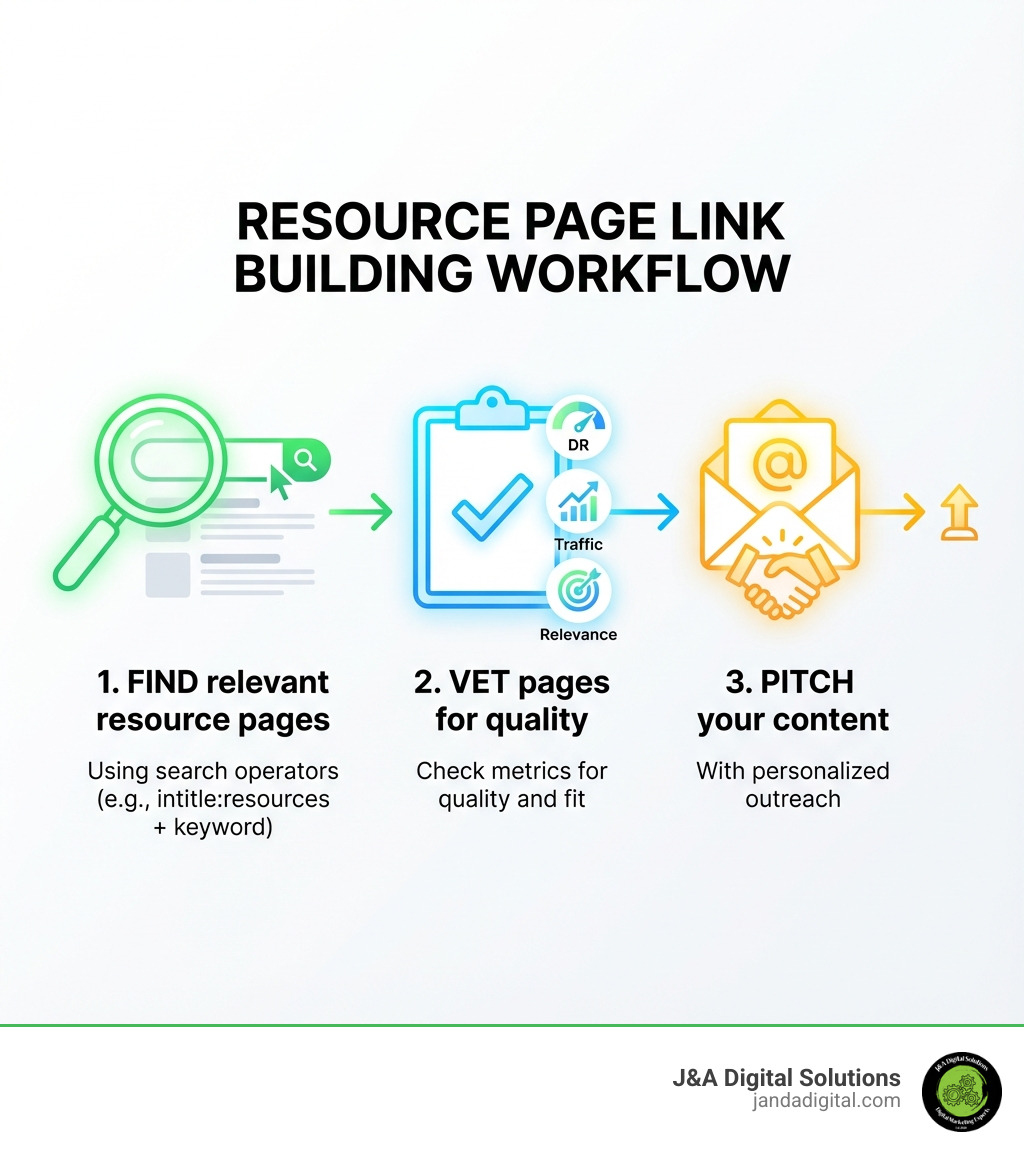
The 3-Step Resource Page Link Building Process:
- Find – Search for relevant resource pages in your industry using search operators like “intitle:resources” plus your keyword
- Vet – Check the page’s Domain Rating (DR), traffic, and relevance to ensure quality
- Pitch – Reach out to the page owner with a personalized email suggesting your content as a valuable addition
This strategy works because it’s a win-win scenario. Resource page owners want to keep their pages fresh and useful. You want quality backlinks that boost your search rankings. When your content genuinely helps their audience, both parties benefit.
According to industry research, 24% of SEOs actively use resource page link building, making it the second most popular link building tactic among professionals. The reason is simple: these links come from pages specifically designed to link out to helpful content, which means higher success rates and more relevant backlinks compared to cold outreach.
For local service businesses, this strategy can drive highly targeted traffic. When someone finds your electrician guide on a home improvement resource page, they’re already interested in your services. That’s better than random website visitors who may never become customers.
I’m Josh Preece, founder of J&A Digital Solutions, and over my 20+ years in digital marketing, I’ve seen Resource page link building consistently deliver quality backlinks that move the needle for local businesses. This guide breaks down exactly how to make it work for you, even if you’ve never built a link before.
Resource page link building terms you need:
Creating Your “Linkable Asset”: The Cornerstone of Success
Before we even think about finding resource pages, we need to ensure we have something truly valuable to offer. Think of your “linkable asset” as the crown jewel of your content – something so useful, insightful, or unique that other websites would genuinely want to link to it. This is the cornerstone of successful resource page link building.
Our goal isn’t just to get a link; it’s to provide genuine value. As experts in digital marketing, we know that low-quality, spammy link building techniques should never be part of a long-term SEO strategy. Instead, we focus on value-added, holistic forms of link building. The key is to create content that is not solely promotional but offers substantial informational value. Service pages, for example, typically don’t belong on resource pages because they serve a different purpose and can appear self-serving.
Instead, we focus on creating:
- In-depth guides: Comprehensive, long-form articles that cover a topic exhaustively. Think of it as your own version of a Wikipedia page, but even better, with expert insights.
- Original research and data: Studies, surveys, or unique data analysis that provides new information to your industry. This positions you as a thought leader and a primary source.
- Free tools or templates: Practical resources that solve a specific problem for your audience.
- Case studies: Real-world examples demonstrating how your solutions achieve results, backed by data.
- Evergreen content: Content that remains relevant and useful over a long period, like a “Beginner’s Guide to [Your Niche]” or “How-To” articles. Resource pages often link to evergreen content, making these links less susceptible to future removal.
The organizations that understand link building as a form of marketing are the ones who win long-term. This means focusing on the user value first. When we create content, we always ask: Does this genuinely help our audience? Does it address common pain points? If the answer is yes, we’re on the right track.
For more on creating impactful content, explore The Power of Superior Content in Digital Marketing.

What Makes Content a Good Fit for Resource Pages?
Content that shines on a resource page is content that truly serves the page’s audience. It’s not just about having information; it’s about having the right information presented in the right way. Here’s what makes content a good fit:
- Comprehensive information: Resource pages are curated collections of valuable information. Your content should be thorough and cover a topic in depth, leaving no stone unturned.
- Unique value proposition: What makes your content stand out? Does it offer a fresh perspective, a novel solution, or a deeper dive than other resources available?
- Expert insights: As J&A Digital Solutions, we bring years of experience to the table. Our content should reflect this, offering authoritative and credible information.
- Data and statistics: Backing up your claims with verifiable data adds immense credibility and makes your content more valuable.
- Actionable advice: Can readers immediately apply what they learn from your content? Practical tips and step-by-step instructions are highly valued.
The goal is to improve the resource page, not just add another link. When your content genuinely improves the quality of the resource page, the owner is more likely to include it. This focus on high-quality content is a core tenet of how we help our clients in Columbus and Lancaster, Ohio, succeed online. For tips on how high-quality content directly translates to better search visibility, check out Discover How High-Quality Content Boosts Google Ranking.
Emulating Successful Resource Page Elements
To create content that gets featured on resource pages, it helps to understand what makes a resource page successful in the first place. Successful resource pages are designed with the user in mind, making it easy to find and digest valuable information.
Key elements we can emulate or learn from include:
- Curated lists: They don’t just dump links; they thoughtfully select the best resources. Our content should aim to be “the best” for a specific sub-topic.
- Clear categorization: Well-organized resource pages group similar links, making navigation intuitive. When pitching, we can suggest where our content best fits.
- Annotations and summaries: Many resource pages provide a brief description of each link. Our pitch should include a concise, compelling summary of our asset.
- Trustworthy sources: Resource pages maintain their credibility by linking to reputable sites. This means our content must be accurate, well-researched, and reflect our expertise. Google itself has increasingly focused on user experience to promote “quality” content.
- User-friendly design: A clean, easy-to-read layout is crucial. Your content should be visually appealing and responsive across devices. This includes optimizing loading times to minimize user frustration.
A resource page is never truly finished; it’s a living document that evolves as new information becomes available. By regularly updating and refreshing our content, we ensure it remains fresh and relevant, increasing its appeal to resource page curators.
A well-designed website, including your resource content, is fundamental to this. Learn more about creating an optimal online experience with our Elevate Your Business with Responsive Web Design Services.
Prospecting: How to Find High-Value Resource Pages
Now that we have our fantastic linkable asset ready, the next step in our resource page link building journey is to find the perfect homes for it. This process, known as prospecting, is where we identify relevant resource pages that would genuinely benefit from linking to our content. This isn’t about casting a wide net; it’s about precision targeting, especially for our clients in Columbus, Ohio, and surrounding areas.
Prospecting for resource pages can be incredibly efficient and scalable if we know where to look. We’re not just looking for generic “resources” pages; we’re also seeking out “listicle” style articles (e.g., “The 10 Best [Topic] Guides”) and “further reading” or “more resources” sections tucked away within blog posts. These often have less competition and can offer high-quality, targeted links.

Using Search Operators to Uncover Opportunities
Google search operators are our secret weapon for finding relevant resource pages. These special commands allow us to refine our searches and pinpoint pages specifically designed to curate external links.
Here’s a list of common search strings we use, combining them with keywords relevant to our content and our clients’ niches (e.g., “Columbus plumber,” “Lancaster SEO,” “Ohio web design”):
[your keyword] inurl:resources[your keyword] intitle:resources[your keyword] "helpful resources"[your keyword] "useful links"[your keyword] "recommended reading"[your keyword] inurl:links.html[your keyword] "best [thing]" (for listicles)[your keyword] "further reading"
For example, if we have a guide on “Eco-Friendly Plumbing Solutions,” we might search for:
"eco-friendly plumbing" inurl:resources"sustainable home" "helpful resources""green living" "recommended reading"
These operators help us cut through the noise and directly target pages that are likely to link out. We can also reverse-engineer competitor backlinks to find resource pages they’re already featured on. If they’re there, and our content is better, we should be too!
Mastering these search techniques is an essential skill in our toolkit. For more on leveraging search effectively, dig into Optimizing SEO Performance with Essential Keyword Research Tools.
Vetting Prospects to Ensure Quality
Finding a potential resource page is just the first step; vetting it is equally, if not more, crucial. We need to ensure that any page we target for a backlink is of high quality and genuinely relevant. A link from a low-quality, spammy site can actually harm our SEO efforts, rather than help them. This is why we are selective and prioritize quality over sheer volume.
Here’s what we look for when vetting prospects:
- Domain Rating (DR) / Domain Authority (DA): These metrics (from tools like Ahrefs or Moz) give us a general idea of a website’s overall strength and authority. While not Google’s direct ranking factors, they correlate strongly with ranking potential. We often look for a minimum DR of 10 or higher.
- Website traffic: Does the page or website receive organic traffic? A resource page with no traffic is unlikely to send referral traffic our way or pass significant SEO value.
- Topical relevance: Is the resource page truly relevant to our content? A link from an unrelated niche won’t be as valuable, and Google may even view it as unnatural.
- Outdated content: Does the resource page look like it hasn’t been updated since 2005? Is it full of broken links? While broken links can be an opportunity (which we’ll discuss next), a generally neglected page might not be worth our time.
- Number of outbound links: Does the page link to an excessive number of external sites? If it’s a huge list of hundreds of links, our link might get lost in the crowd and its value diluted.
- Manual review: This is perhaps the most important step. We manually visit each potential resource page. We check if it links to external resources, if those resources are topically related, and if the page appears well-maintained and provides value to its users. We also look for signs that the site is actively accepting submissions or has contact information readily available.
By carefully vetting each prospect, we ensure that our resource page link building efforts are focused on acquiring high-quality, impactful backlinks that genuinely contribute to our clients’ SEO success in competitive markets like Columbus and Lancaster. Building a strong, clean backlink profile is essential for modern SEO. Dive deeper into backlink strategies with Mastering Backlinks in 2023: Making it Simple.
The Art of the Pitch: Effective Outreach for Resource Page Link Building
Once we’ve identified and vetted our high-value resource pages, the next critical step is outreach. This is where the “art” comes in. A well-crafted pitch can open doors, while a generic or poorly thought-out email can quickly land us in the spam folder. Our goal is to build relationships and demonstrate genuine value.
The outreach process involves personalization, finding the right contact information, clearly articulating our value proposition, and following up strategically. We know that 8 out of 10 buyers prefer to be contacted by email, so this is our primary channel.
Crafting the Perfect Outreach Email
An effective outreach email for resource page link building isn’t just about asking for a link; it’s about offering a solution. We aim to make it easy for the resource page owner to say “yes.”
Here are the key elements we include:
- Personalized greeting: Always address the recipient by name. Generic “Hello Webmaster” emails are a red flag. We spend the extra time to find the exact person responsible for the page. This is something that applies to everything in business – reaching out to the correct person means a much higher success rate.
- Mentioning their page: Start by referencing their specific resource page and something you genuinely appreciate about it. This shows you’ve done your homework. For example, “I was browsing your ‘Best Local Business Resources for Columbus’ page and really enjoyed your section on marketing tips.”
- Explaining your resource’s value: Clearly and concisely explain what your content is about and why it would be a valuable addition to their page. Focus on how it benefits their audience, not just how it benefits you. Highlight unique insights, data, or comprehensive coverage.
- Suggesting a placement: If the resource page has distinct categories or sections, suggest where your link would fit naturally. This removes guesswork for them. For instance, “I believe our guide on ‘Optimizing Google Business Profiles for Local SEO in Ohio’ would be a perfect fit under your ‘Local Marketing Strategies’ section.”
- Clear call-to-action: Make it easy for them to take the next step. “Would you be open to reviewing it for inclusion?” or “Let me know if you think it would be a good addition.”
- Professionalism and courtesy: Our tone is always respectful and helpful. We aren’t demanding a link; we’re suggesting a mutually beneficial opportunity.
We also pay close attention to any instructions provided by the page owner regarding how they prefer to receive resource suggestions. Honoring their preferences demonstrates professionalism and consideration.
The Broken Link Building Method
One of the most powerful tactics within resource page link building is broken link building. This strategy leverages a common problem on the web – dead links – to create a win-win opportunity.
Here’s how we approach it:
- Identifying dead links: While vetting resource pages, we use tools like Chrome extensions (e.g., Broken Link Checker) or other specialized broken link checkers. These tools quickly scan a page and highlight any links that lead to a 404 error.
- Providing value: Once we find a broken link, we then check if our linkable asset covers the same topic or offers a superior, updated alternative to the dead resource.
- Offering a replacement: In our outreach email, we politely inform the resource page owner about the broken link. This immediately positions us as helpful. Then, we suggest our relevant content as a replacement. For example, “I noticed a broken link on your page [URL of their page] under the ‘Digital Marketing Tools’ section, specifically for the link about ‘SEO Keyword Research.’ We recently published a comprehensive guide on Keyword Research Mastery: Your 2023 SEO Guide that I believe would be an excellent, up-to-date replacement.”
- Increasing success rate: Proactively pointing out these issues and offering a solution significantly increases our chances of getting a backlink. Website owners appreciate having a cleaner, more functional resource page. This approach can 2-10x our conversion rate compared to standard outreach.
This method transforms a potential frustration for the website owner into an opportunity to improve their content, making them much more receptive to our pitch.
Evaluating the Strategy: Pros, Cons, and Measuring ROI
Like any SEO strategy, resource page link building has its advantages and disadvantages. Understanding these helps us set realistic expectations and optimize our efforts for our clients in Columbus and Lancaster, Ohio.
Here’s a quick overview:
The Pros and Cons of Resource Page Link Building
Pros:
- High-quality links: Resource pages are designed to link to valuable external content. This often means the links we acquire are highly relevant and authoritative, passing significant SEO value.
- Scalable process: With the right tools and systematic approach (like the one we’ve outlined), finding and pitching resource pages can be scaled to generate a consistent flow of backlinks.
- White-hat and ethical: This is a completely legitimate and Google-approved method of link building, focusing on value exchange rather than manipulative tactics.
- Targeted traffic: Visitors from resource pages are often pre-qualified and highly interested in the topic, leading to better referral traffic and potentially higher conversion rates for our clients.
- Boosts brand authority: Being featured on reputable resource pages improves our clients’ credibility and positions them as experts in their field.
Cons:
- Can be time-consuming: Prospecting, vetting, finding contact information, and crafting personalized emails all take time and effort.
- Conversion rates can vary: While generally higher than cold outreach, not every pitch will result in a link. Some resource page owners may be unresponsive or have strict linking policies.
- Limited availability: Depending on the niche, there might not be an endless supply of high-quality resource pages to target.
- Content dependency: Success heavily relies on having truly exceptional “linkable assets” to offer. If our content isn’t top-notch, our pitches will fall flat.
Despite some of the challenges, the fact that resource page link building was the 2nd most popular link building strategy among SEO professionals highlights its enduring effectiveness and value in the SEO landscape.
Measuring Your Link Building Success
To truly understand the impact of our resource page link building efforts, we need to measure our success. This goes beyond just counting links; it involves analyzing how those links contribute to our overall SEO goals.
Here are key metrics we track:
- Tracking new backlinks: We monitor how many new backlinks we acquire from resource pages. This is our primary quantitative measure of outreach success.
- Monitoring keyword rankings: Do the pages we’re building links to see an improvement in their keyword rankings? Higher rankings for relevant keywords are a strong indicator of SEO progress. For example, our clients in Columbus or Lancaster might see their service pages rank higher for “best plumber in Columbus Ohio” or “SEO services Lancaster Ohio.”
- Referral traffic analysis: We look at Google Analytics to see if resource pages are sending direct referral traffic to our site. This indicates engaged users who found our content valuable enough to click through.
- Conversion tracking: Links should lead to business results. We track if the traffic from these resource pages converts into leads, sales, or other desired actions for our clients.
- Domain Authority (DA) / Domain Rating (DR) improvement: While not direct ranking factors, an increase in these metrics often correlates with improved search visibility and authority.
We use various SEO tools to help us track these metrics and gain insights into our campaign performance. Measuring success isn’t just about proving ROI; it also helps us refine our strategies, identify what’s working, and continuously improve our resource page link building efforts. For a deeper dive into effective marketing metrics for SEO, read Professional Insights on Effective Marketing Metrics for SEO.
Frequently Asked Questions about Resource Page Link Building
We often get asked common questions about resource page link building. Here are some of the most frequent ones:
Is it okay to pay for a link on a resource page?
Absolutely not. Buying links is directly against Google’s guidelines. Google considers paid links to be “link spam” because they are solely for the purpose of manipulating page rank. Engaging in such practices can lead to severe penalties for your site, including manual actions and a significant drop in search rankings. It also damages your site’s reputation and credibility. Our focus at J&A Digital Solutions is always on building organic, white-hat links based on genuine value and relevance. If someone offers payment in exchange for a link on a resource page, it’s a huge red flag, and chances are that resource page will be pretty useless and spammy anyway.
How is this different from guest posting?
While both are valuable SEO strategies for acquiring backlinks, resource page link building and guest posting are quite different:
- Resource Page Link Building: The goal here is usually a link insertion within an existing resource page. You’re pitching your already-created, high-quality content to be added to a curated list. This requires less new content creation on your part for each link, as you’re leveraging an asset you already have. The outreach is focused on demonstrating how your existing content improves their page.
- Guest Posting: This involves writing an entirely new article (a “guest post”) for another website’s blog. The goal is to get a byline link back to your site within that new article. This requires significant content creation effort for each opportunity and often a different kind of relationship building with the blog owner.
Both methods are effective, but they serve different purposes and require distinct outreach approaches.
How many outreach emails should I send to get one link?
This is a tricky question because the conversion rate for resource page link building can vary widely. It depends on several factors:
- Quality of your content: Truly exceptional content will always have a higher success rate.
- Quality and relevance of the target page: Highly relevant, well-maintained pages are more likely to respond positively.
- Personalization of your email: Generic emails perform poorly. Highly personalized pitches that show you’ve done your research perform much better.
- Your industry/niche: Some industries are more open to linking than others.
- Luck: Sometimes, it just comes down to the right person seeing your email at the right time.
There’s no universal industry benchmark for exactly how many emails equal one link. However, by focusing on quality prospecting, creating outstanding content, and crafting personalized pitches, we aim to maximize our conversion rates. The majority of pages on the web get no traffic from Google, so securing links from influential, traffic-generating resource pages is far more valuable than simply accumulating a high number of low-quality links.
Conclusion
Resource page link building stands as a robust and enduring strategy in the changing landscape of SEO. It’s a testament to the power of providing genuine value and building bridges, not just links. We’ve explored how creating exceptional, linkable content, carefully prospecting for relevant resource pages, and crafting personalized, value-driven outreach emails are the keys to success.
This method is a white-hat approach that aligns perfectly with Google’s emphasis on quality and user experience. By consistently acquiring high-quality backlinks from authoritative resource pages, we not only boost our clients’ search rankings but also improve their brand authority and drive highly targeted referral traffic. For businesses in Columbus, Lancaster, and across Ohio, this means dominating “near me” searches and converting more local leads.
At J&A Digital Solutions, we are experts in navigating these complexities and building powerful backlink profiles that deliver tangible results. We believe in strategic, ethical link building that creates long-term SEO assets for your business.
For expert help in building a powerful backlink profile and dominating local search, explore our SEO services.