

A Delicious Guide to Restaurant Franchise Marketing Plans
What Is a Restaurant Franchise Marketing Plan (And Why It Matters)
A solid restaurant franchise marketing plan is the difference between a location that thrives and one that quietly struggles — even under a nationally recognized brand.
Here’s a quick overview of what an effective plan covers:
- Define your goals — Set SMART objectives for both brand growth and local customer acquisition
- Split your strategy — Separate national brand campaigns from local store marketing
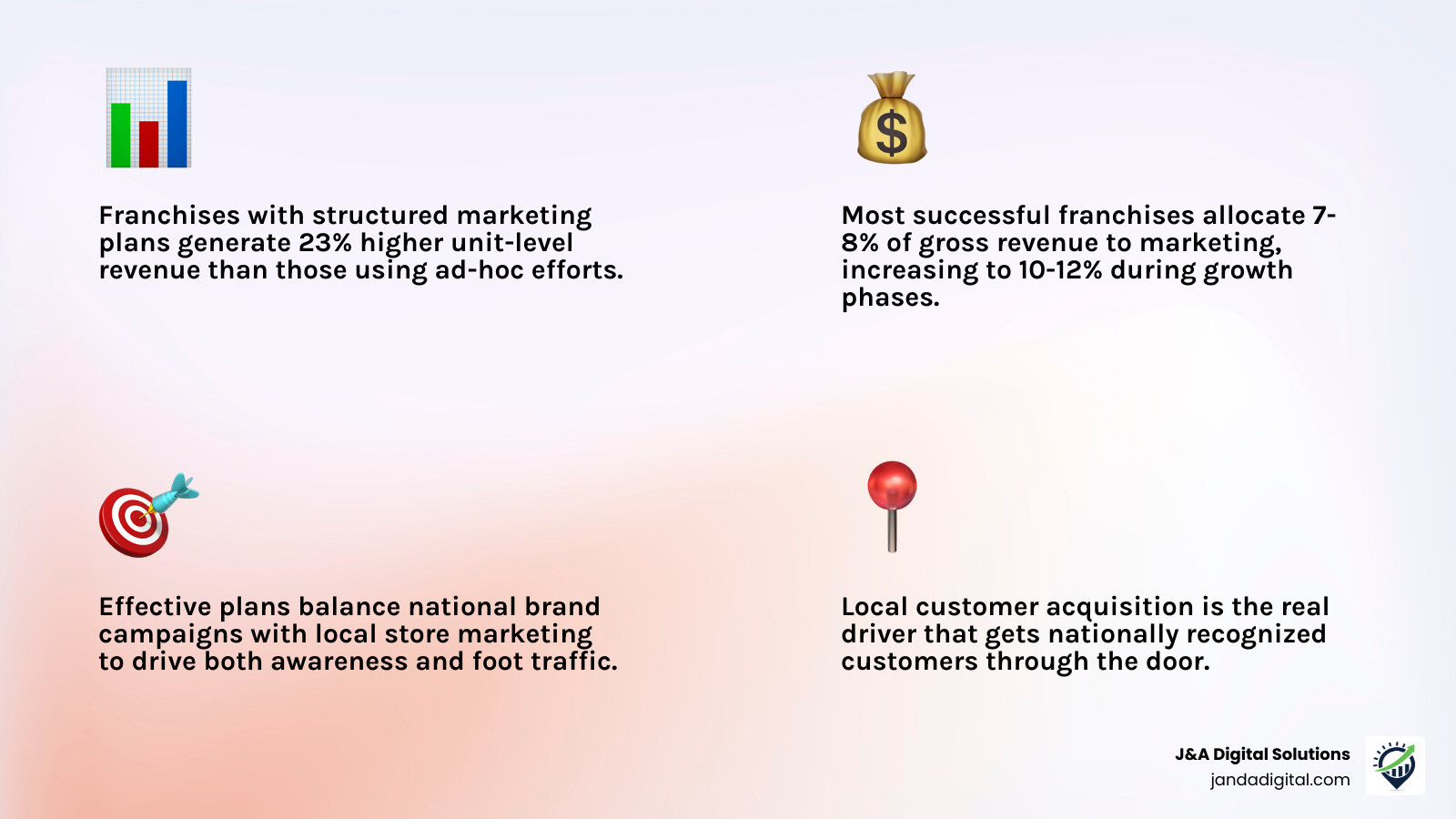
- Allocate your budget — Aim for 7–8% of gross revenue (up to 10–12% during growth phases)
- Choose your channels — Local SEO, social media, email, SMS, paid ads, and offline tactics
- Empower franchisees — Provide templates, training, and approved marketing materials
- Track and optimize — Monitor location-level metrics and adjust quarterly
Many franchise owners assume the brand will do the heavy lifting for them. It won’t — at least not entirely. National brand recognition gets customers curious. Local marketing is what gets them through your door.
Franchise businesses with a structured marketing plan generate 23% higher unit-level revenue than those running ad-hoc efforts. That gap exists because great franchise marketing works on two levels at once: corporate-level brand building and franchisee-level local customer acquisition.
This guide breaks down exactly how to build a plan that does both.
I’m Josh Preece, founder of J&A Digital Solutions, with over 20 years of experience in web development and digital marketing helping local businesses build measurable, lead-generating systems — including crafting a reliable restaurant franchise marketing plan framework for multi-location growth. The strategies in this guide come from real-world experience, not theory.
Restaurant franchise marketing plan vocabulary:
The Essential Components of a Restaurant Franchise Marketing Plan
Restaurant franchise marketing is not the same as general restaurant marketing.
A single-location restaurant usually focuses on one trade area, one owner, and one brand voice. A franchise has to market at multiple levels at once:
- The franchisor builds the overall brand
- Regional groups or co-ops may support area campaigns
- Individual franchisees drive traffic in their own neighborhoods
That makes a restaurant franchise marketing plan more complex, but also more powerful when it is organized properly.
The two main types of franchise marketing are:
- Operational marketing
- Development marketing
Operational marketing is customer-facing. Its job is to bring in diners, increase repeat visits, promote menu items, support online ordering, and improve local visibility.
Development marketing is franchise-facing. Its job is to attract qualified franchise buyers, support expansion, and help the brand grow into new territories.
For restaurant brands, both matter. If operational marketing is weak, units underperform. If development marketing is weak, expansion slows. One fills tables. The other fills territories.
Core building blocks every plan needs
Your plan should include these essentials:
- SMART goals
- Audience segmentation
- Brand rules and local flexibility
- Budget allocation
- Channel strategy
- Franchisee support tools
- Performance measurement
SMART goals keep everyone honest. Instead of saying, “We want more customers,” say, “Increase lunch traffic by 12% in Q3” or “Grow online ordering revenue by 18% over six months.”
Budget matters too. The SBA commonly recommends investing 7-8% of gross revenue into marketing, and many franchise systems in aggressive growth phases may need 10-12%. On top of that, franchisees often contribute around 3-5% of monthly gross revenue to a national advertising fund.
Here is a simple way to think about the split:
| Marketing area | Main purpose | Typical use |
|---|---|---|
| National ad fund | Build brand awareness and run system-wide campaigns | Brand campaigns, seasonal promotions, major creative assets |
| Regional or co-op spend | Support shared market opportunities | Area promotions, regional media, market testing |
| Local store marketing | Drive visits to specific locations | Local SEO, community events, paid local ads, review generation |
A practical plan also needs documentation. That means campaign calendars, approved creative, offer guidelines, local promotion rules, and a way to report results by location rather than only system-wide averages. Otherwise, one strong market hides three weak ones, and nobody knows why.
For more frameworks on scalable franchise strategy, explore our guide on Marketing A Franchise Best Strategies.

Balancing National Brand Consistency with Local Customization
This is where many restaurant franchises either become beautifully coordinated or gloriously chaotic.
Customers expect consistency from a franchise. They want the same logo, tone, promise, and baseline experience whether they visit one location or another. That consistency is a huge advantage.
But local customers also respond better when a restaurant feels connected to their community. That means your marketing cannot be 100% corporate and 0% local. It has to balance both.
A good rule of thumb is this:
- National controls the brand foundation
- Local adapts the execution
Corporate should usually own:
- Logos
- Colors
- typography and design standards
- brand voice
- menu naming rules
- seasonal campaign themes
- legal disclaimers
- approved offers and creative templates
Franchisees should usually have room to tailor:
- community event participation
- local partnerships
- location-specific social content
- neighborhood offers
- geo-targeted paid ads
- localized landing pages
- messaging around weather, events, and local habits
For restaurants, local customization can be especially important because food preferences are personal and regional. Even when menus stay standardized, promotions can still be localized. One location may lean into office lunch traffic. Another may focus on family dinner bundles. Another may promote game-day takeout.
Community engagement is one of the safest and strongest forms of local customization. Sponsoring a school event, partnering with a nearby gym, participating in fundraisers, or supporting a local charity creates relevance without breaking brand rules.
This is also where ghost kitchens and virtual expansion can fit into the conversation. For some restaurant franchises, lower-overhead delivery-first models can help test demand in a market before committing to full brick-and-mortar expansion. It is not the right fit for every concept, but it can be a useful growth tool when aligned with the brand.
The key is giving franchisees freedom inside a fence. Not a tiny fence, and definitely not an open field with no rules.
Helpful reading:
- How To Rank Every Franchise Location On Page One Without Breaking A Sweat
- Seo For Restaurants How To Go From Zero To Hero

Multi-Channel Strategies for Modern Restaurant Franchises
The best restaurant franchise plans do not rely on one channel. They combine high-intent digital tactics with practical offline marketing that still drives foot traffic.
That matters because 86% of total retail sales still happen at brick-and-mortar locations. For restaurant franchises, online marketing should ultimately support an offline action: a visit, an order, a reservation, or a repeat purchase.
Here are the channels we see matter most.
Digital strategies that work
Local SEO
If your restaurant does not appear when someone searches “lunch near me” or “best burgers near me,” you are losing traffic to whoever does. Local SEO is one of the highest-intent channels available because the customer is already hungry. Marketing does not get much warmer than that.
Email marketing
Email remains one of the strongest ROI channels, often returning $36 for every $1 spent. It works well for:
- loyalty reminders
- limited-time offers
- new menu launches
- event promotions
- segmented campaigns by location or customer behavior
SMS marketing
Branded text message open rates can reach 98%, which is ridiculous in the best possible way. SMS is ideal for:
- flash promotions
- reminder messages
- loyalty rewards
- bounce-back offers
- event day campaigns
The main rule: use it carefully. Nobody wants 11 texts about mozzarella sticks before noon.
Paid search and paid social
Geo-targeted Google Ads and paid social can be effective for:
- grand openings
- new menu launches
- lunch and dinner rush promotion
- delivery and carryout campaigns
- competitor conquesting within a local radius
Online ordering and delivery visibility
A modern restaurant franchise plan should include how locations show up across ordering touchpoints, including the website, mobile experience, maps, and delivery platforms. Marketing and operations have to work together here. A great ad campaign is wasted if ordering is clunky or menu data is inconsistent.
Offline tactics that still work
Traditional marketing is not dead. It just prefers smaller trade areas and clearer offers.
The most effective offline franchise tactics often include:
- direct mail to nearby households
- door hangers in key neighborhoods
- local radio in select markets
- in-store table tents and window clings
- grand opening events
- school and sports sponsorships
- fundraiser nights
- partnerships with offices, apartment communities, and nearby retailers
A good example is using direct mail plus digital retargeting. Someone gets a coupon in the mailbox, visits the website, then sees a reminder ad later. That is old-school and new-school playing nicely together.
Optimizing Your Restaurant Franchise Marketing Plan for Local SEO
Local SEO deserves its own section because it often becomes the difference between a busy location and a painfully quiet one.
A restaurant franchise should optimize local search at the location level, not just the brand level. That means every location needs its own digital footprint.
Focus on these basics first:
- Google Business Profile
- Location pages
- Consistent local citations
- Reviews and responses
- Map pack optimization
- Local content
Google Business Profile
Every location should have a fully completed profile with:
- correct name, address, and phone number
- accurate hours
- menu or ordering links
- updated photos
- categories and attributes
- posts when relevant
Reviews and reputation management
Reviews are huge in restaurant marketing. Research shows 76% of consumers read online reviews regularly, and more than 70% say reviews for food and drink businesses are important or very important.
That means each location needs a process to:
- ask for reviews
- monitor them
- respond quickly
- escalate service issues when needed
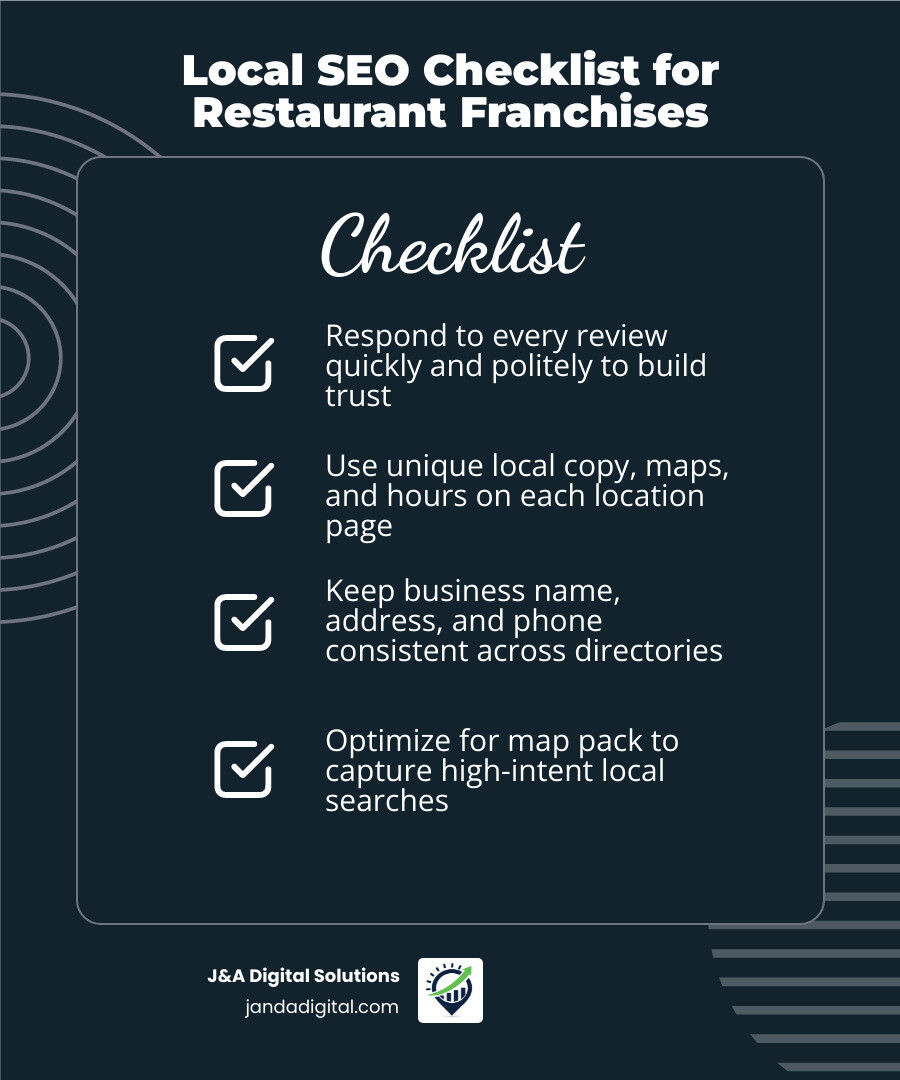
We recommend responding to positive and negative reviews alike. Fast, polite replies build trust and often improve conversion from search.
Location pages
Each franchise location should have its own page on the website with:
- unique local copy
- directions and embedded maps
- menu highlights
- hours
- ordering options
- parking or access info
- nearby landmarks or neighborhood references
This helps Google understand the page and helps humans decide whether to visit.
Local citations and map pack visibility
Your restaurant’s business information should match across directories and platforms. Inconsistencies confuse search engines and customers. That hurts rankings and trust.
Map pack visibility matters because the top local results absorb a huge share of high-intent clicks, calls, and driving directions.
If local rankings are a priority, our team spends a lot of time helping businesses dominate nearby searches. You can also explore these resources:
- Seo For Restaurants How To Go From Zero To Hero
- How To Rank Every Franchise Location On Page One Without Breaking A Sweat
- Franchise Marketing Explained So Simply Even Your Dog Would Get It
Integrating Social Media into Your Restaurant Franchise Marketing Plan
Social media works especially well for restaurants because food is visual, emotional, and easy to share. One strong post can make someone hungry in under three seconds.
In 2026, restaurant franchise social strategy should focus on a mix of consistency and local personality.
What works best:
- short-form video
- user-generated content
- behind-the-scenes clips
- staff spotlights
- limited-time offer promotion
- geo-targeted local ads
- local influencer partnerships
- review screenshots and guest stories
User-generated content is gold because it feels real. Encourage customers to tag locations, share meal photos, and participate in local promotions. Franchisees should have clear guidance on what they can post, how to respond to comments, and when to escalate issues.
Social also gives you real-time feedback. Customers tell you what they loved, what disappointed them, and what they wish you offered. That is valuable market research hiding inside your comment section.
For franchises, the smartest setup is usually:
- corporate creates brand campaigns and core assets
- local stores customize captions, timing, and community relevance
- performance gets tracked by location
If you want a broader look at franchise social and inbound strategies, visit Why Your Franchise Needs Inbound Marketing To Attract Better Leads.
Frequently Asked Questions about Restaurant Franchise Marketing
What is the typical marketing budget for a restaurant franchise?
A common benchmark is 7-8% of gross revenue for total marketing, with some systems spending 10-12% during growth or in highly competitive markets.
A restaurant franchise budget often includes:
- national ad fund contribution: roughly 1-5% of gross sales depending on the system
- regional co-op contribution: often 0.5-1% where applicable
- local store marketing spend: often 2-5%
- technology and tools: CRM, SMS, email, reputation software, analytics
- creative and production: photos, video, templates, signage
- training and franchisee support
The important part is not just how much you spend, but how clearly the budget is assigned and tracked.
How do operational and development marketing differ?
Operational marketing focuses on customer demand for current locations. It includes:
- local SEO
- paid ads for store traffic
- social media promotions
- review generation
- email and SMS retention
- local events and partnerships
Development marketing focuses on franchise growth. It includes:
- franchise opportunity pages
- lead generation for new franchisees
- discovery funnel campaigns
- trade events
- franchise-specific content and nurturing
In simple terms:
- operational marketing sells meals
- development marketing sells the opportunity to own the business
Both need different messaging, different landing pages, and different KPIs.
Why is local SEO critical for franchise success?
Because restaurant decisions are often immediate and local.
People search for what they want, near where they are, right now. Local SEO helps your locations appear in those high-intent moments. It also supports map pack rankings, review trust, driving directions, and mobile discovery.
And since 86% of retail sales still happen in physical locations, showing up in local search is directly tied to revenue for most restaurant franchises.
Without local SEO, even a strong brand can disappear from the exact searches that lead to walk-ins and online orders.
Conclusion
A strong restaurant franchise marketing plan should give your brand structure, give franchisees clarity, and give each location a real chance to win locally.
That means:
- brand consistency at the top
- local flexibility in the field
- clear budgets
- strong digital foundations
- proven offline support
- location-level tracking
- ongoing optimization
At J&A Digital Solutions, we help small to medium-sized businesses generate guaranteed hot local leads through a proprietary lead generation system built to dominate “near me” searches. Our approach is designed to bring in real customers without the usual guesswork, and our 5 Lead Guarantee keeps the process low-risk and results-focused.
If you want help building a smarter, more measurable franchise growth strategy, start here: More info about franchise marketing strategies
Additional helpful resources: